
Peptide Reconstitution: The Definitive Laboratory Protocol for 2026
Precision peptide reconstitution is not just a simple mixing step; it’s a critical management of molecular thermodynamics that determines whether your research succeeds or fragments before it even begins. Recent independent testing from Aesura Health in March 2026 revealed that a significant percentage of online products fail to meet label claims or suffer from bacterial contamination. With the May 2026 USP updates for trace metal impurities raising the bar for pharmaceutical purity, you can’t afford to lose expensive materials to improper handling or unstable solutions.
You’ve likely felt the frustration of molecular degradation or the uncertainty of inaccurate dosage calculations during sensitive in-vitro analysis. We’re here to ensure those variables don’t compromise your results. This guide provides the definitive laboratory protocol to help you master the science of peptide reconstitution, ensuring total molecular integrity and experimental accuracy. You’ll learn how to standardize your protocols to meet 2026 standards, maximize the shelf-life of your research peptides, and achieve the high-purity solutions your work demands. We’ll walk through the exact ratios and stabilization techniques required to transform lyophilized powder into a stable, high-performance medium.
Key Takeaways
- Understand how freeze-drying protects molecular bonds and why precise restoration is vital for maintaining stability.
- Choose the right solvent for your research by comparing the preservative benefits of Bacteriostatic Water against Sterile Water for Injection.
- Protect your research materials from molecular shearing by mastering vacuum pressure management during peptide reconstitution.
- Implement a standardized laboratory protocol to eliminate contamination risks and ensure every dosage calculation remains perfectly accurate.
- Learn how HPLC verification and initial powder purity serve as the essential benchmarks for achieving elite experimental results.
Understanding Lyophilization and the Necessity of Reconstitution
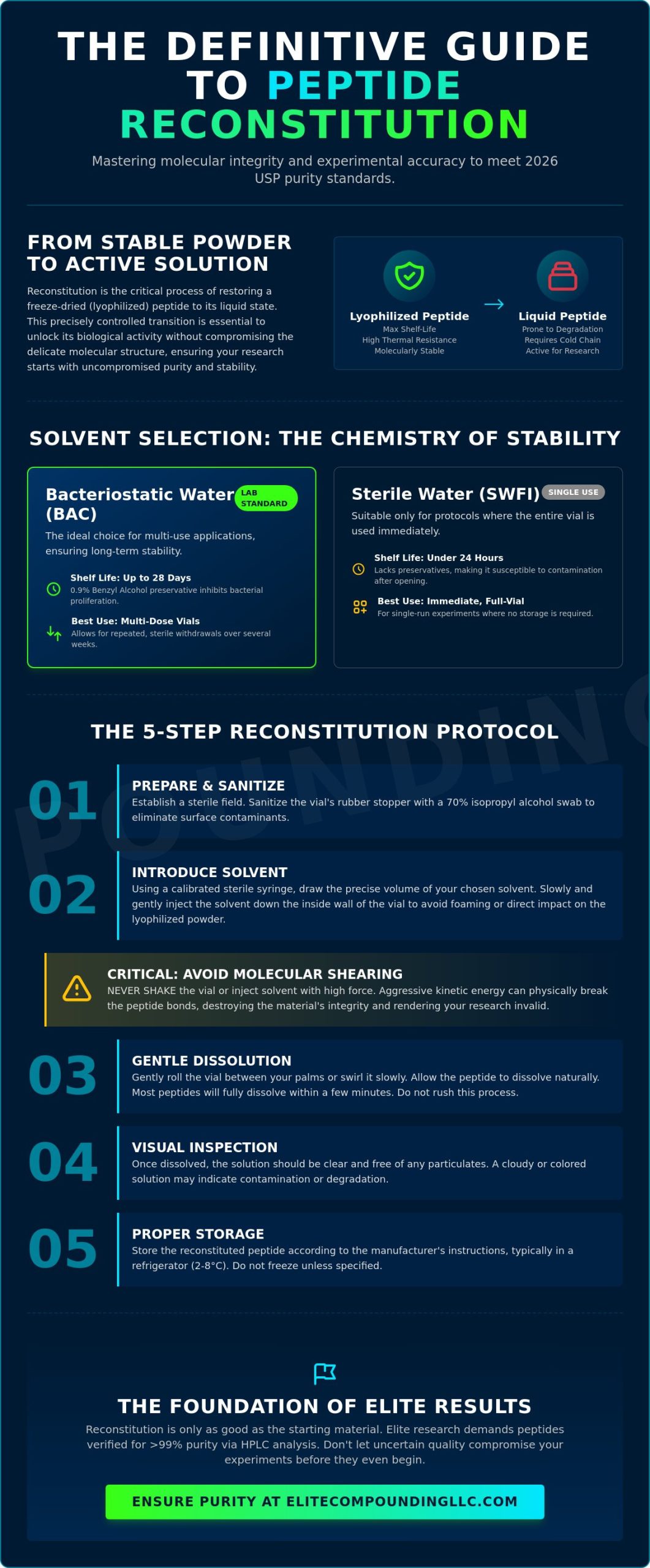
Peptide reconstitution is the critical process of restoring a freeze-dried (lyophilized) cake back to its liquid state for laboratory analysis. It’s the bridge between secure storage and active research. When you receive a vial, you’re holding a concentrated molecular structure that has been stabilized for long-term survival. Mastering this transition is the only way to ensure the peptide’s biological activity remains consistent across your experiments. Without a precise protocol, you risk damaging the very molecules you’re trying to study.
To reach this stable state, manufacturers utilize a sophisticated method known as lyophilization. By freezing the material and then reducing the surrounding pressure, water is removed via sublimation. This allows moisture to transition directly from a solid to a gas without passing through the liquid phase. It effectively locks the peptide bonds in place, preventing the degradation that naturally occurs in aqueous environments. This sophisticated facilitation of stability is what allows high-purity research materials to be stored and shipped worldwide.
Shipping peptides as solids isn’t just about convenience; it’s about maximizing shelf-life and thermal resistance. Liquid peptides are prone to rapid fragmentation, especially when exposed to temperature fluctuations during transit. A lyophilized solid acts as a resilient vault for the amino acid sequence. This allows the researcher to create a perfectly homogenous solution for precise volumetric measurement. Whether you’re conducting in-vitro analysis or complex assays, this accuracy is the foundation of elite laboratory standards.
The Molecular Fragility of Synthetic Peptides
Synthetic peptides consist of delicate amino acid chains that are surprisingly fragile. In their dehydrated form, these chains are susceptible to “shearing.” This occurs when rapid pressure changes or aggressive kinetic energy physically breaks the molecular structure. To maintain purity levels above 99%, you must handle these vials with extreme care. Think of the peptide as a high-performance tool that requires a gentle touch to remain effective. Don’t shake or agitate the vial, as even small amounts of kinetic energy can lead to fragmentation.
Environmental Baselines for Reconstitution
Success begins with a controlled environment. You should standardize your laboratory temperature and humidity to ensure consistent results every time you perform a peptide reconstitution. A sterile, non-reactive surface is mandatory to prevent microscopic contaminants from entering the vial. Before you begin, ensure your workspace is equipped with these essentials:
- 70% Isopropyl alcohol swabs for sanitizing vial stoppers.
- Calibrated, sterile syringes for precise solvent delivery.
- Bacteriostatic water or sterile water for injection.
- A stable, vibration-free workspace with adequate lighting.
Solvent Selection: The Chemistry of Peptide Stability
The choice of solvent is the primary determinant of your peptide’s functional lifespan and molecular stability. Selecting the wrong medium doesn’t just hinder solubility; it can actively trigger degradation before your analysis begins. Bacteriostatic Water (BAC) is the recognized laboratory standard for multi-use applications. It utilizes 0.9% benzyl alcohol as a preservative to inhibit bacterial proliferation, effectively extending the vial’s shelf life to 28 days post-reconstitution. Without this preservative, Sterile Water for Injection (SWFI) is limited to a 24-hour window, making it suitable only for immediate, single-use protocols.
Some advanced research requires handling hydrophobic sequences that refuse to dissolve in standard aqueous solutions. In these cases, specialized solvents like Dimethyl Sulfoxide (DMSO) or dilute Acetic Acid are necessary to bridge the gap. These agents lower the interfacial tension of the lyophilized cake, allowing the peptide to enter the solution without clumping or precipitation. To ensure your laboratory maintains these elite standards of accuracy, you should always verify the solubility profile of your research peptides before introducing a solvent.
pH Management and Buffer Solutions
Amino acid solubility is extremely sensitive to the pH of the surrounding medium. If the solvent is too far removed from the peptide’s isoelectric point, the molecule may aggregate or lose its structural integrity. Utilizing Phosphate-Buffered Saline (PBS) is a sophisticated way to maintain a physiological pH of 7.4. This buffer mimics biological environments and provides a stable foundation for long-term storage, preventing the acidic shifts that often lead to peptide fragmentation. Maintaining this balance is essential for meeting the strict purity standards anticipated in the May 2026 USP updates.
Solvent-to-Solute Ratios for Precise Calculation
Precision in peptide reconstitution relies on standardized solvent-to-solute ratios. A common protocol involves using 1ml or 2ml of solvent for 5mg or 10mg vials to create a predictable concentration. When the concentration is too high, the volume required for each assay becomes so small that the margin for volumetric error increases significantly. This risk can compromise the reproducibility of your data. Achieving a concentration of 5mg per 1ml is the ideal standard for high-resolution experimental analysis because it balances ease of handling with professional-grade precision.
Managing Atmospheric Pressure and Vacuum Seals
Laboratory peptides arrive sealed under a vacuum to preserve their molecular integrity against oxidation. This negative pressure is a double-edged sword. While it protects the lyophilized cake during storage, it creates a significant risk during the initial stage of peptide reconstitution. If you insert the needle and allow the vacuum to pull the solvent in unchecked, the resulting “spray” causes severe molecular shearing. This mechanical stress can fragment the amino acid chains, rendering your expensive research material useless before the first assay. You must control the entry speed to maintain the high-purity standards required for 2026 laboratory compliance.
Atmospheric conditions play a hidden role in this process that many researchers overlook. In high-altitude laboratory environments, the delta between the internal vacuum and external pressure is reduced. This shift can make the vacuum feel “weak,” leading some to force the solvent in manually. Conversely, at sea level, the vacuum is aggressive. You must act as a sophisticated facilitator of the pressure exchange. Always use the “slow-drip” technique by aiming the needle at the glass wall of the vial. This allows the solvent to slide down the side, gently saturating the powder rather than crashing into it and causing aerosolization of the solute.
Techniques for Pressure Equalization
Achieving a neutral pressure state is vital for accurate dosing and preventing the loss of material. If the vial remains under negative pressure, it will fight against the syringe when you try to draw back your solution. Use the “air-gap” method to balance the environment. Draw an amount of air into an empty syringe equal to the solvent volume you added, then inject it into the vial headspace. You’ve succeeded when the plunger stays stationary without being pulled in or pushed back by the internal atmosphere.
Avoiding Mechanical Stress During Mixing
The “no-shake” rule is the most important standard for maintaining molecular integrity. High-purity peptides are exceptionally sensitive to kinetic energy. Agitation leads to foaming, which traps the peptide in the vial’s headspace and leads to inaccurate volumetric measurements. Instead, utilize a gentle swirling motion between your palms. If you encounter stubborn solutes, don’t increase the force. Implement the 15-minute “rest and revisit” method. Allowing the vial to sit undisturbed gives the solvent time to penetrate the core of the lyophilized cake naturally, ensuring a reliable peptide reconstitution without damaging the delicate amino acid bonds.
Step-by-Step Laboratory Reconstitution Protocol
Executing a flawless peptide reconstitution requires more than just technical knowledge; it demands a disciplined adherence to sterile technique and molecular preservation. Standardizing your laboratory procedure ensures that every assay starts with a pristine, high-purity sample. This five-step protocol is designed to meet the rigorous standards of 2026 laboratory environments, providing a reliable path from lyophilized powder to a stable solution.
- Step 1: Sanitization. Thoroughly clean your workspace with a laboratory-grade disinfectant. Use 70% isopropyl alcohol swabs to sanitize the rubber stoppers of both the solvent vial and the peptide vial. Allow them to air-dry completely to prevent alcohol from entering the solution.
- Step 2: Calculation and Draw. Using a sterile, calibrated syringe, draw the precise volume of solvent required for your desired concentration. Double-check your volumetric math to ensure the final concentration aligns with your experimental design.
- Step 3: Controlled Introduction. Insert the needle at a slight angle. Aim the solvent stream directly against the glass wall of the vial. This allows the liquid to flow down the side, gently saturating the cake and preventing the molecular shearing discussed in previous sections.
- Step 4: Homogenization. Gently swirl the vial in a slow, circular motion. Continue this process until the solution is entirely clear and colorless. Never shake the vial, as this introduces air bubbles and mechanical stress.
- Step 5: Compliance Labeling. Immediately label the vial with the exact date of reconstitution and the calculated concentration (e.g., 5mg/ml). This is a critical step for maintaining laboratory transparency and tracking the effective window of the material.
Precision in preparation is only half the battle. To maintain the integrity of your results, you must also utilize high-purity research peptides that have been verified through HPLC analysis.
Post-Reconstitution Storage and Aliquoting
Once reconstituted, peptides become significantly more vulnerable to environmental degradation. Most solutions require constant refrigeration between 2-8°C for short-term use. If your study spans several months, you should divide the solution into single-use vials, known as aliquots, and store them at -20°C. This prevents repeated freeze-thaw cycles, which cause protein denaturation and structural fragmentation. Refer to our guide on cold-chain logistics to understand how temperature management impacts long-term molecular viability.
Stability Timelines for Common Research Peptides
Different sequences possess varying degrees of inherent stability. For instance, BPC-157 is known for its relative resilience post-mixing, often maintaining its integrity for the full 28-day window in bacteriostatic water. In contrast, mitochondrial-derived peptides like MOTS-C are far more sensitive and may begin to degrade within a shorter timeframe. Always monitor your vials for visual cues of degradation, such as cloudiness, persistent particulates, or unexpected color shifts. If the solution is no longer clear, its purity is compromised, and it should be discarded to protect the accuracy of your research.
Elite Standards: Ensuring Purity Before Reconstitution
The most rigorous peptide reconstitution protocol cannot compensate for sub-par starting material. If the lyophilized cake contains residual impurities or moisture, the resulting solution will never reach the stability required for elite research. Success begins with a commitment to initial purity. We ensure that every vial meets a 99%+ purity threshold, providing the reliability you need for high-stakes institutional analysis. Without this foundation, your experimental results remain vulnerable to variables you can’t control.
High-Performance Liquid Chromatography (HPLC) is the cornerstone of this quality assurance. This analytical method separates the peptide from any synthesis byproducts, verifying the exact amino acid sequence and purity level. When you request a Certificate of Analysis (CoA) for your batch, don’t just look at the final percentage. Analyze the HPLC chromatogram for a single, sharp peak. A sharp peak confirms molecular homogeneity, whereas multiple smaller peaks indicate the presence of truncated sequences or residual solvents that could compromise your findings.
Sourcing High-Purity Research Materials
The “gray market” for research materials is fraught with hidden risks, including high concentrations of Trifluoroacetic Acid (TFA) and excessive moisture content. TFA is a common byproduct of solid-phase synthesis. If it isn’t properly removed, it can alter the pH of your solution and lead to rapid degradation. Florida-based laboratories like Elite Compounding offer a superior level of quality control, operating as a sophisticated facilitator for researchers who value transparency and batch consistency. Maintaining this consistency is vital for multi-phase longitudinal studies where even a 1% variance in purity can derail your data sets.
Conclusion: The Path to Precision Research
Mastering the science of peptide reconstitution is a prerequisite for experimental reproducibility. By managing everything from vacuum pressure to solvent selection, you protect the molecular integrity of your materials and ensure the accuracy of every volumetric measurement. Before you begin your next assay, run through this final checklist: sanitize the workspace, verify your solvent-to-solute ratio, use the slow-drip technique, and confirm the purity of your source material. Precision isn’t just a goal; it’s a standard you must uphold to achieve next-level results in your laboratory.
Secure high-purity research peptides for your laboratory today.
Elevate Your Laboratory Standards for 2026
Achieving elite results in molecular research requires a seamless transition from a lyophilized solid to a stable liquid. We’ve detailed how managing vacuum pressure prevents shearing and why selecting the correct solvent extends your effective research window. These protocols are the benchmark for any laboratory seeking to eliminate variables and protect expensive materials. It’s not just about the mixing process; it’s about preserving the structural integrity of your high-purity compounds from the moment the vial is opened.
Your progress depends on the synergy between precise technique and superior source material. Mastering peptide reconstitution is the final step in securing the experimental accuracy your work demands. We provide the foundation for this precision by delivering 99%+ purity verified through rigorous HPLC and MS testing for every batch. As a trusted partner for Florida research institutions, we utilize specialized cold-chain shipping to maintain molecular stability throughout the entire delivery process.
Order Lab-Grade Research Peptides from Elite Compounding LLC and take the next step in your optimization journey. Your research deserves the security and sophistication of professional-grade tools.
Frequently Asked Questions
How much bacteriostatic water should I add to a 5mg peptide vial?
You should typically add 1ml or 2ml of bacteriostatic water to a 5mg vial to achieve a manageable concentration for laboratory analysis. Adding 1ml creates a concentration of 5mg/ml, while 2ml results in 2.5mg/ml. This standardized ratio is a fundamental part of peptide reconstitution that ensures your volumetric measurements remain precise and reproducible across different assays.
Can I use normal saline instead of bacteriostatic water for reconstitution?
You can use normal saline for immediate, single-use applications, but it lacks the essential preservatives required for multi-day storage. Saline doesn’t contain benzyl alcohol, which means the solution is susceptible to bacterial growth and must be discarded within 24 hours. For any study requiring a multi-use vial, bacteriostatic water is the professional standard for maintaining stability over a 28-day window.
What happens if I accidentally shake the peptide vial after adding the solvent?
Shaking the vial causes mechanical stress and molecular shearing that can fragment the delicate amino acid chains. This aggressive agitation often leads to foaming, which traps the peptide in the vial’s headspace and makes accurate dosing nearly impossible. If you accidentally agitate the vial, let it rest in a refrigerator until the bubbles settle, though some degree of molecular denaturation may have already occurred.
How long can a reconstituted peptide stay at room temperature before it degrades?
Reconstituted peptides should remain at room temperature for no more than a few hours before significant molecular fragmentation begins. While the lyophilized powder is designed for thermal resistance during shipping, the liquid state is highly volatile and sensitive to kinetic and thermal energy. To preserve the integrity of your solution, always return the vial to a temperature-controlled environment immediately after use.
Why is the peptide solution cloudy after mixing, and is it still safe for research?
A cloudy solution indicates that the peptide hasn’t fully dissolved or that the solvent pH is incompatible with the specific sequence. Persistent cloudiness can also be a sign of contamination or advanced molecular degradation. If the solution remains opaque after a 15-minute “rest and revisit” period, it fails to meet elite purity standards and should be discarded to protect the validity of your data.
Do I need to equalize the pressure in the vial before drawing my dose?
You must equalize the internal pressure to ensure that the vacuum doesn’t interfere with your volumetric accuracy. Balancing the atmosphere within the vial prevents the plunger from being pulled in or pushed back by negative pressure. This step is a critical component of professional peptide reconstitution that allows for a smooth, precise draw-back of the required solution volume.
Can I mix two different peptides in the same vial for an experiment?
You should never combine two different peptides in a single vial because they may cross-react or aggregate, altering their biological activity. Each peptide sequence has a unique isoelectric point and requires specific environmental conditions to remain stable. Mixing them creates an uncontrolled variable that compromises the purity of your materials and invalidates the results of your in-vitro analysis.
What is the best temperature for long-term storage of reconstituted peptides?
The best temperature for short-term storage is between 2°C and 8°C, while long-term preservation requires freezing at -20°C. For studies extending beyond one month, you should divide the solution into single-use aliquots before freezing to avoid damaging freeze-thaw cycles. This dual-temperature protocol is the most effective way to maximize the lifespan and potency of your research peptides.