Research Chemical Safety: The 2026 Procurement and Laboratory Handling Guide
Your experimental integrity is only as reliable as your most recent shipment. In a landscape where a single contaminant can nullify months of data, the burden of research chemical safety has shifted from simple lab hygiene to a sophisticated procurement strategy. You know that verifying a vendor’s legitimacy is often a high-stakes guessing game; it’s a challenge to decipher complex Certificates of Analysis while keeping pace with evolving global regulations.
We provide the precision-driven protocols you need to vet research peptide shops and handle high-purity compounds with absolute confidence. This guide offers a clear framework for validating 98% purity standards through HPLC and Mass Spectrometry data, ensuring your materials meet the elite requirements of modern science. You’ll gain a streamlined path to compliance, covering everything from the May 2026 OSHA hazard communication updates to standardized protocols for handling lyophilized powders. We’ll walk you through the essential steps to secure your supply chain and protect your laboratory from the $165,514 penalties associated with willful regulatory violations. By mastering these procurement and handling standards, you ensure that your focus remains on optimization and progress rather than administrative risk.
Key Takeaways
- Identify high-standard vendors using a rigorous three-tier vetting process that prioritizes third-party HPLC and Mass Spectrometry verification.
- Implement advanced laboratory protocols for research chemical safety, focusing on the prevention of aerosolization during the reconstitution of lyophilized powders.
- Navigate the complex 2026 regulatory landscape in Florida and the US to ensure your procurement remains fully compliant with updated OSHA and EPA standards.
- Master cold-chain storage logistics to preserve the delicate molecular structure of research peptides and maintain their experimental potency.
- Bridge the gap between clinical-grade purity and research ambition by sourcing materials that guarantee reproducible data and elite performance outcomes.
The Foundations of Research Chemical Safety in 2026
True experimental success isn’t just about the hypothesis; it’s about the precision of your tools. In 2026, research chemical safety is no longer a passive checklist. It represents the critical intersection of chemical purity, handling protocols, and environmental control. This triad ensures that your laboratory remains a secure environment for high-level discovery. The evolution of safety standards in 2026 reflects a shift toward batch-specific transparency and real-time verification. By strictly adhering to foundational laboratory safety principles, researchers protect both their physical workspace and the integrity of their data.
The ‘Research Use Only’ (RUO) mandate is your first line of defense. This classification isn’t just a legal formality. It’s a safety protocol that distinguishes high-purity, experimental compounds from mass-market or industrial chemicals. In the current regulatory environment, failing to respect this distinction leads to cross-contamination and isomer variability, risks that can compromise months of work. When you operate within the RUO framework, you acknowledge that these materials require specialized handling that exceeds standard commercial safety requirements.
Risk Mitigation Through Strict Compound Classification
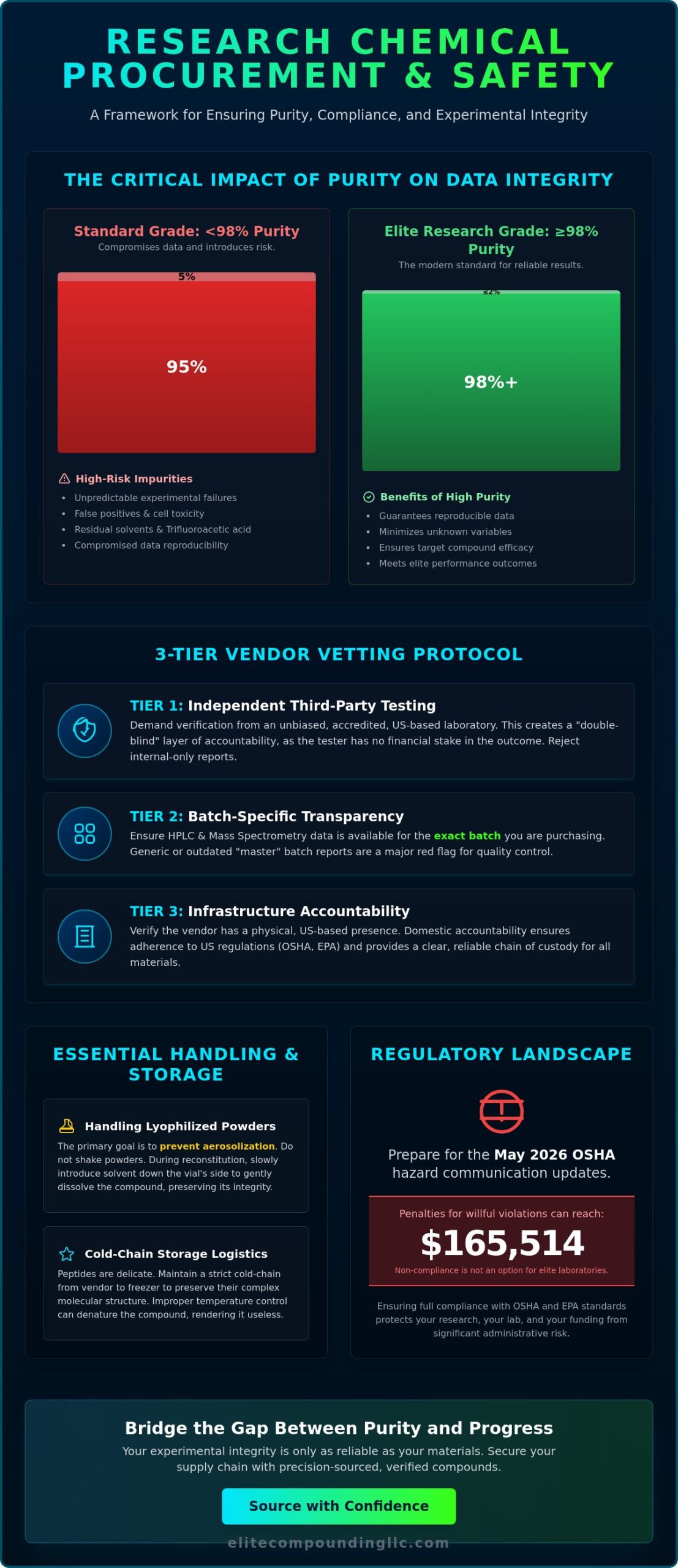
Precision begins with understanding the chemical grade hierarchy. While technical-grade materials suffice for industrial cleaning, and ACS-grade chemicals meet general laboratory standards, Research Grade peptides require a higher level of scrutiny. Purity is a safety metric. For in-vitro studies, a compound that’s only 95% pure contains 5% unknown variables. These impurities aren’t just ‘noise’ in your data; they’re reactive agents that can cause unpredictable experimental failures. The role of the Sophisticated Facilitator is to maintain supply chain integrity, providing the elite, precision-driven tools necessary for those who value accuracy over convenience.
The Impact of Impurity on Experimental Data Integrity
Small errors in synthesis create massive problems in the lab. Residual solvents or high levels of Trifluoroacetic acid (TFA) can alter biological assays, leading to false positives or cell toxicity. In 2026, the baseline for ‘acceptable’ purity in peptide research has moved to 98% or higher. Anything less introduces the risk of unintended peptide sequences. These truncated or misfolded sequences can mimic the target compound’s behavior while producing different biochemical results. Maintaining a rigorous environment for research chemical safety and sourcing from verified vendors isn’t just about compliance. It’s about ensuring your results are reproducible and your laboratory remains a sanctuary for precision-driven science.
Vetting a Research Chemical Shop: Purity and Verification Standards
Safety in the laboratory starts at the point of purchase. You can’t rely on internal laboratory reports provided by a manufacturer; these are often biased or outdated. To maintain true research chemical safety, you must demand third-party verification from independent, US-based facilities. This ensures a “double-blind” layer of accountability where the tester has no financial stake in the sale. A professional research chemical shop should provide batch-specific data that matches the exact vial in your hand, not a generic “representative” sample from years ago. Domestic accountability is equally vital. A US-based presence ensures the vendor adheres to local regulations and provides reliable logistics that protect the compound’s integrity during transit.
Use this 3-tier vetting process to evaluate any potential supplier:
- Independent Third-Party Testing: Verification must come from an unbiased, accredited laboratory.
- Batch-Specific Transparency: HPLC and MS data must be available for every unique production run, not just a “master” batch.
- Infrastructure Accountability: The vendor must have a verifiable physical presence and a clear chain of custody for their materials.
How to Read a 2026 Certificate of Analysis (COA)
In 2026, a valid COA is more than a PDF with a logo. You need to examine the High-Performance Liquid Chromatography (HPLC) chromatogram for a clean, singular peak. A 98% purity rating is the modern industry standard, but the remaining 2% matters. Analyze the baseline for any “shouldering” on the primary peak, which often indicates the presence of closely related impurities or isomers. Mass Spectrometry (MS) provides the secondary layer of verification, confirming the molecular weight is precise to the dalton. This ensures you’ve received the exact sequence requested. Look for digital red flags like inconsistent fonts or dates that don’t align with current Harvard chemical safety guidelines. If the data looks altered, the compound is a risk to your study.
Verifying Vendor Reputation in the Scientific Community
Trust is earned through transparency and consistent peer-reviewed feedback. Many researchers utilize community forums like Reddit’s research chemical groups to cross-reference vendor reliability and shipping consistency. However, institutional references and a history of bulk supply to established laboratories carry more weight than anonymous comments. Elite Compounding LLC sets the standard here by maintaining a results-oriented documentation portal. This provides researchers with a transparent sourcing experience while ensuring every compound meets rigorous 2026 standards for sequence accuracy. This level of sophisticated facilitation removes the guesswork from procurement, allowing you to prioritize research chemical safety without sacrificing experimental momentum.
Laboratory Protocols for Handling High-Purity Peptides and Chemicals
Precision in the lab is a discipline. Once you’ve secured high-purity compounds, the focus shifts to maintaining that integrity during the experimental phase. Research chemical safety requires a proactive approach to physical handling, starting with the right Personal Protective Equipment (PPE). For lyophilized powders, standard nitrile gloves and lab coats are foundational, but safety goggles meeting ANSI Z358.1-2014 standards are non-negotiable. These tools protect you from accidental splashes or aerosolized particles during the high-stakes reconstitution process. Always use fume hoods or laminar flow benches when working with concentrated liquids or fine powders to ensure a controlled environment and prevent inhalation risks.
Proper disposal is equally critical to institutional health. In 2026, the EPA has fully enforced the phase-out of substances like methylene chloride, and laboratories must have active Workplace Chemical Protection Programs in place. Improper disposal isn’t just a safety risk; it’s a financial liability. With regulated medical waste disposal averaging between $0.30 and $0.80 per pound in 2026, cutting corners can lead to OSHA penalties of up to $16,550 for a single serious violation. Adhering to these standards ensures your laboratory remains an elite, secure space for scientific advancement.
Safe Reconstitution and Dilution Techniques
Reconstitution is where many experimental errors occur. You must select the correct diluent, typically bacteriostatic water or sterile water, to maintain peptide stability and prevent degradation. The most common risk is vacuum-induced spray. Most high-quality vials are vacuum-sealed; if you insert a needle without equalizing pressure, the liquid can spray violently, causing aerosolization of the compound. Introduce the diluent slowly against the side of the vial wall. Avoid mechanical stress or aggressive agitation. Sensitive sequences require a gentle swirling motion rather than shaking to preserve their delicate molecular structure.
Contamination Control in Controlled Environments
Maintaining aseptic conditions is vital when your study involves multiple-use vials. You should strictly follow the ‘One-Needle, One-Vial’ rule to eliminate the possibility of cross-compound contamination. Every entry into a vial must be preceded by a thorough alcohol swab of the septum. Environmental monitoring is also a key component of research chemical safety. In 2026, precision-driven labs utilize digital sensors to maintain strict temperature and humidity controls. Fluctuations in these variables can compromise chemical stability, leading to inconsistent data and wasted resources. By controlling these factors, you ensure your research remains reliable and your results remain reproducible.
Legal Compliance and Storage Logistics for Experimental Compounds
Compliance is the backbone of sustainable research. As of May 19, 2026, the OSHA Hazard Communication Standard requires all chemical labels and Safety Data Sheets (SDS) to align with the latest GHS revisions. This isn’t just a bureaucratic hurdle; it’s a vital component of research chemical safety that ensures every compound in your facility is identifiable during an emergency. Maintaining a clear paper trail of procurement protects your institution from liability and simplifies oversight during internal audits. In Florida and across the US, researchers must distinguish between controlled substances and unregulated research peptides to remain within legal boundaries. A robust documentation strategy turns regulatory pressure into a competitive advantage by proving your commitment to precision and safety.
Cold-chain logistics are equally essential for maintaining the molecular integrity of your compounds. Peptides are sensitive to thermal fluctuations; even brief exposure to ambient temperatures can trigger degradation. High-purity materials require a seamless transition from the manufacturer to your freezer to prevent structural breakdown. By standardized labeling and rigorous tracking, you ensure that every vial’s history is transparent and every experimental variable is accounted for. To ensure your laboratory operates with the highest level of institutional oversight, you can source research peptides that come with full regulatory documentation.
Storage Stability: Temperature and Light Sensitivity
Precision storage extends the lifespan of your materials. Lyophilized powders typically remain stable at -20°C for short-term use, but long-term storage often requires -80°C to prevent any minute enzymatic activity. Photo-sensitive compounds are particularly vulnerable. Exposure to light can lead to toxic byproduct formation, which compromises both research chemical safety and your final data. Use amber vials or opaque secondary containment to mitigate this risk. Implementing a First-In, First-Out (FIFO) inventory system ensures you never use expired chemicals, keeping your experimental results consistent and reliable.
Regulatory Frameworks for Research Procurement
Modern procurement requires a deep understanding of institutional compliance. While many research peptides are unregulated, they still require meticulous handling and storage according to NFPA 45 standards for chemical cabinets. Safety Data Sheets (SDS) serve as the primary resource for emergency response and toxicity information. Every professional research chemical shop must provide an updated Safety Data Sheet (SDS) that aligns with the May 2026 OSHA GHS revisions to ensure immediate access to toxicity and emergency response data. This ensures that your lab remains a secure, high-performance environment dedicated to progress.
Why Precision Sourcing Defines Successful Experimental Outcomes
Scientific progress relies on the total elimination of variables. When your materials are inconsistent, your results are invalid. The correlation between chemical purity and the reproducibility of scientific data is absolute; a single percent of variance in peptide sequence can lead to wildly different biological responses. By prioritizing research chemical safety throughout the procurement phase, you remove the “purity noise” that often plagues complex assays. Sourcing from a Florida-based laboratory with elite quality standards ensures that your supply chain is resilient and your compounds are verified before they ever reach your bench. This shift from procurement anxiety to experimental confidence allows you to focus on your discovery rather than questioning your tools.
Elite Compounding LLC bridges the gap between clinical authority and research ambition. We understand that high-level science requires more than just a product; it requires a secure, frictionless environment for innovation. By maintaining a no-nonsense approach to quality and transparency, we provide researchers with the precision-driven tools necessary for personal and professional development. Choosing a partner that values your time and intelligence means you spend less time vetting and more time executing your study protocols with absolute certainty.
Elite Compounding LLC: The Professional Choice for 2026
Our commitment to excellence is reflected in every batch we produce. We provide high-purity research peptides backed by verifiable, batch-specific COAs that meet the rigorous standards of the 2026 scientific landscape. We’ve streamlined the procurement process for both institutional and independent laboratory environments, ensuring that elite-tier materials are accessible without unnecessary complications. We act as a sophisticated facilitator for your work, supporting the scientific community with materials that guarantee accuracy and sophistication.
Next Steps for Your Laboratory Research
Securing the integrity of your next study is a straightforward process. If you’re managing an institutional analysis that requires bulk supply, our dedicated support team is available to assist with specific chemical specifications and complex logistics. We ensure that your research chemical safety requirements are met through meticulous documentation and secure cold-chain handling. You don’t have to settle for ambiguous quality or questionable origins. Explore our high-purity research chemical shop for your next study and experience the performance-minded precision that defines successful research. Initiating your order today secures the high-standard resources you need for your next breakthrough.
Elevating Your Research Standards for 2026
Mastering the complexities of procurement and laboratory management ensures your study remains on the cutting edge of discovery. You’ve learned that research chemical safety hinges on batch-specific HPLC and Mass Spectrometry verification, alongside meticulous handling of lyophilized powders. By aligning your lab with 2026 regulatory standards and utilizing elite-tier cold-chain logistics, you protect your data from the variables that lead to experimental failure. Success in the lab is a direct result of the precision-driven tools you choose to employ.
Elite Compounding LLC facilitates this journey by providing a high-standard, Florida-based platform for institutional and independent researchers alike. It’s time to move past procurement anxiety and toward consistent, reproducible results. Secure your high-purity research supply at Elite Compounding LLC to experience the difference that verified purity and sophisticated facilitation make. Your next breakthrough depends on the integrity of your materials; build your foundation on excellence today.
Frequently Asked Questions
What are the most common safety risks in a research chemical shop?
Common risks include cross-contamination from low-tier synthesis and the presence of residual solvents. In a professional research chemical shop, these hazards are mitigated through strict batch-specific testing. Substandard compounds introduce reactive isomers that can ruin experimental data. You must also account for the risk of aerosolization during the reconstitution of lyophilized powders. Using high-end PPE and laminar flow benches is the standard protocol for minimizing these physical and data-driven risks.
How do I verify the purity of peptides for research purposes?
Verification requires a dual-track analytical approach using HPLC and Mass Spectrometry. High-Performance Liquid Chromatography (HPLC) determines the purity percentage by separating the compound from impurities. Mass Spectrometry (MS) confirms the identity by measuring molecular weight. Together, these tests provide the precision needed for elite research. You should always request the raw chromatogram data rather than a summary to ensure the results are authentic and specific to your current batch.
Is it legal to buy research chemicals online in 2026?
Procurement of research chemicals online remains legal in 2026 as long as the materials are strictly labeled for ‘Research Use Only’ (RUO). These compounds are intended for laboratory and in-vitro studies rather than human or veterinary use. It’s vital to stay informed about regional regulations in Florida and federal mandates. Compliance ensures your institutional standing remains secure while you access the high-purity tools necessary for scientific advancement and optimization.
What should I look for in a peptide Certificate of Analysis (COA)?
A valid Certificate of Analysis must feature a clear HPLC peak and a molecular weight confirmation through Mass Spectrometry. Look for a purity level of 98% or higher to ensure experimental reproducibility. You should also check for a recent date and a batch number that matches your vial. Red flags include blurry digital files or inconsistent fonts, which often suggest data tampering or the use of outdated laboratory reports.
How should research peptides be stored to maintain safety and efficacy?
Proper storage involves maintaining a stable environment of -20°C for most lyophilized powders. For long-term preservation, -80°C is preferred to halt all enzymatic activity. You must protect these vials from light exposure and moisture, as both can trigger rapid degradation or the formation of toxic byproducts. Consistent cold-chain management is a fundamental aspect of research chemical safety, protecting the delicate molecular structure of your compounds from thermal stress.
Why is third-party testing critical for research chemical safety?
Third-party testing is the only way to ensure an unbiased assessment of a compound’s purity and identity. Relying on a manufacturer’s internal data creates a conflict of interest that can compromise your study. Independent verification is a non-negotiable pillar of research chemical safety because it provides an objective paper trail for institutional oversight. This transparency allows you to proceed with your experiments knowing the materials meet the highest precision standards in the industry.
What is the difference between research-grade and pharmaceutical-grade chemicals?
Research-grade chemicals are synthesized specifically for laboratory environments and in-vitro studies. They prioritize high purity and batch-specific data to ensure results are reproducible. Pharmaceutical-grade chemicals are manufactured under different regulatory frameworks for clinical applications. While both require high standards, the research-grade classification allows scientists to access elite, precision-driven tools that are strictly intended for experimental discovery rather than mass-market retail or medical diagnosis.
Can I use a peptide calculator to determine safety margins for in-vitro studies?
Peptide calculators are effective tools for determining precise concentrations and molarity in an experimental setting. They help you establish accurate dilutions for in-vitro studies, ensuring your cellular assays receive the exact amount of compound required. While these tools assist with mathematical precision, they don’t replace the need for rigorous laboratory handling protocols. Use them to streamline your preparation process and maintain the high standards of accuracy your research demands.
https://shorturl.fm/ltCND