Research Peptides: The 2026 Laboratory Gold Standard Guide
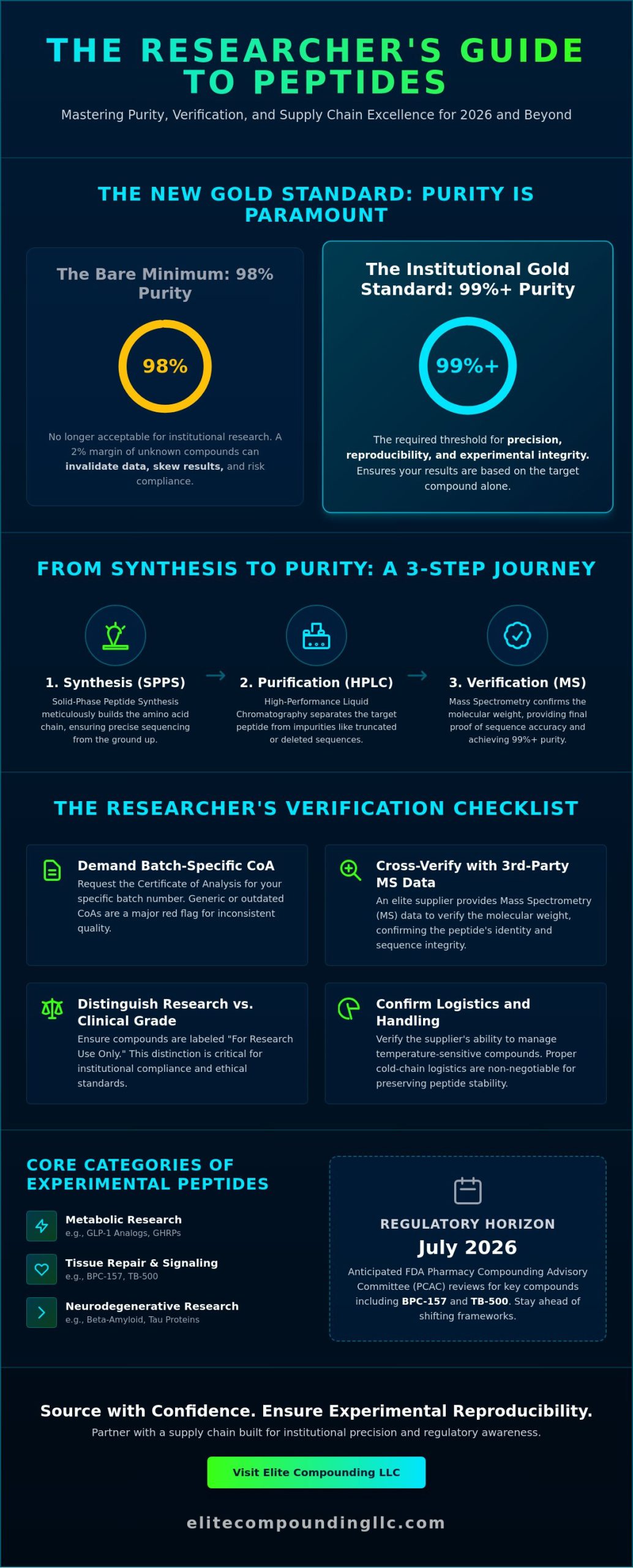
In 2026, a 98% purity rating is no longer the hallmark of excellence; it’s the bare minimum for a field that has shifted toward a rigorous 99% gold standard. You recognize that in precision laboratory analysis, even a fractional margin of error can invalidate months of data and jeopardize institutional compliance. It’s exhausting to filter through vendors who offer inconsistent batches, provide outdated Certificates of Analysis, or fail to manage the complex logistics of temperature-sensitive compounds.
This guide will empower you to master the technical landscape of high-purity research peptides and identify institutional-grade supply chains built for precision. You’ll learn how to verify chemical integrity using the latest High-Performance Liquid Chromatography (HPLC) and Mass Spectrometry (MS) standards. We’ll also preview the critical July 2026 FDA Pharmacy Compounding Advisory Committee reviews for compounds like BPC-157 and TB-500. By the end of this analysis, you’ll have a clear roadmap to establish a reliable supply chain that ensures your experimental reproducibility remains unshakeable and your laboratory stays ahead of shifting regulatory frameworks.
Key Takeaways
- Understand the 2026 scientific frontier where synthetic peptides drive modern drug discovery and metabolic signaling research.
- Learn how Solid-Phase Peptide Synthesis and HPLC purification achieve the 99% purity standard required for precision results.
- Master the researcher’s checklist to verify research peptides through batch-specific Certificates of Analysis and third-party Mass Spectrometry data.
- Navigate the distinction between research-grade and clinical-grade standards to ensure institutional compliance and experimental integrity.
- Identify the hallmarks of elite supply chains, focusing on high-standard synthesis and rigorous verification processes for laboratory use.
What are Research Peptides? Defining the 2026 Scientific Frontier
Research peptides represent the cutting edge of biochemical signaling and molecular exploration. To understand the foundation of this field, one must first ask: What are peptides? At their core, they’re short chains of amino acids linked by covalent bonds, acting as the primary messengers in almost every biological system. In a controlled laboratory setting, research peptides are synthesized specifically for in-vitro and in-vivo investigation. They allow scientists to isolate specific cellular pathways and observe biological responses with surgical precision, making them indispensable in modern drug discovery.
It’s vital to maintain a clear professional boundary regarding these materials. Research-grade compounds aren’t intended for human consumption or medical diagnosis. They’re precision tools for discovery, designed to push the boundaries of what’s possible in metabolic and regenerative science. In 2026, the success of any experimental model depends entirely on sequence precision. If the amino acid chain is off by even a single link, the resulting data is worthless. This absolute focus on accuracy is what separates elite institutional research from generic catalog ordering.
The Evolution of Peptide Science
The field has moved far beyond the cumbersome natural extraction methods of the past. Today, high-throughput automated synthesis allows for the creation of complex sequences that were once impossible to replicate. AI-driven modeling now predicts how these sequences will interact with specific receptors before a single vial is even produced. Research peptides are the building blocks of experimental biochemistry. This evolution ensures that modern labs can focus on results rather than synthesis hurdles. While some providers focus solely on recombinant production, the use of Solid-Phase Peptide Synthesis (SPPS) provides the flexibility needed for custom sequences and rapid iteration in fast-paced research environments.
Core Categories of Experimental Peptides
Modern research typically falls into three primary categories, each requiring specific purity thresholds to ensure experimental reproducibility:
- Metabolic Research Sequences: These include GLP-1 analogs and Growth Hormone Releasing Peptides (GHRPs) used to study insulin sensitivity, weight regulation, and metabolic signaling.
- Tissue Repair and Signaling Molecules: Compounds like BPC-157 and TB-500 are central to studies involving cellular regeneration, angiogenesis, and inflammatory response modulation.
- Neurodegenerative Research Tools: High-purity Beta-Amyloid and Tau proteins are essential for labs investigating the mechanics of cognitive decline and protein misfolding.
Choosing the right category depends on your specific experimental goals. Each sequence must be verified to ensure it matches the intended molecular weight and structure. This level of detail is what allows researchers to move from hypothesis to breakthrough without the interference of chemical impurities or sequence errors. While scientists focus on these microscopic signaling pathways, those interested in the macroscopic effects of cellular turnover on skin rejuvenation can discover Skin Culture Home Skin Peel to see how regenerative principles are applied in professional-grade peeling treatments.
The Biochemistry of Precision: How High-Purity Peptides are Synthesized
Precision in the laboratory isn’t an accident; it’s the result of a rigorous chemical journey that begins with Solid-Phase Peptide Synthesis (SPPS). This method serves as the industry foundation for sequence accuracy, allowing amino acids to be added one by one to a solid resin support. In 2026, the margin for error has narrowed significantly. While some vendors previously settled for 95% purity, modern institutional standards now demand a minimum of 99% to ensure experimental reproducibility. Achieving this elite level requires more than just basic synthesis; it demands a sophisticated purification protocol that removes truncated sequences and deleted peptides.
High-Performance Liquid Chromatography (HPLC) acts as the primary purification engine, stripping away synthesis byproducts that could otherwise skew your data. Understanding counter-ion selection is equally critical for successful analysis. Most research peptides are synthesized as TFA (Trifluoroacetic acid) salts, which is the standard for most analytical work. However, sensitive cell-culture assays or specific biological models may require Acetate or HCl versions to prevent potential cytotoxicity. Recognizing the dangers of unregulated research peptides that fail to meet these stringent synthesis benchmarks is the first step toward securing reliable results. For labs requiring documented 99%+ purity, sourcing through a professional research facilitator ensures these biochemical standards are met.
The Purification Process
Mass Spectrometry (MS) is the final arbiter of identity, verifying the molecular weight of the synthesized sequence against its theoretical mass. This step ensures the peptide you receive is exactly what you ordered. Elite suppliers focus on “Single Peak” purity, where the HPLC chromatogram shows a sharp, isolated peak with no underlying shoulders or baseline noise. This level of clarity removes residual solvents and ensures that your experimental environment remains free from toxic contaminants that could trigger unintended cellular responses.
Stability and Storage Standards
Lyophilization, or freeze-drying, is the 2026 gold standard for maintaining long-term stability and research consistency. This process removes moisture without damaging the peptide’s delicate structure, resulting in a stable powder. Once received, lyophilized peptides should be stored at -20°C or -80°C to prevent degradation. It’s vital to avoid frequent freeze-thaw cycles; instead, adopt a standardized protocol for aliquoting your peptides into single-use vials immediately after reconstitution. Protecting these compounds from light and moisture is not just a suggestion; it’s a requirement for maintaining the integrity of your longitudinal studies.
Research-Grade vs. Clinical-Grade: Navigating Regulatory Standards
The boundary between research-grade and clinical-grade materials is defined by legal intent and manufacturing oversight. Research-grade research peptides are synthesized specifically for laboratory use, operating under a framework that excludes human application or diagnostic utility. This distinction isn’t just a label; it’s a fundamental regulatory requirement. Laboratories must adhere to Good Laboratory Practice (GLP) standards to ensure that every experimental variable is controlled and documented. Sourcing from the gray market introduces unacceptable risks. Budget vendors often lack the oversight required to prevent batch-to-batch variance, which directly compromises the integrity of your longitudinal data.
Institutional Review Boards (IRB) play a critical role in this ecosystem. They mandate that all materials used in a study meet specific ethical and quality benchmarks. If a researcher can’t prove the provenance and purity of their compounds, the study may be halted or the results disqualified. Professional laboratories prioritize transparency and rigorous documentation to satisfy these institutional requirements. This high-standard approach moves beyond the simple acquisition of chemicals; it’s about maintaining a secure and informed research environment. A comprehensive understanding of research chemical safety and 2026 procurement protocols is essential for any institution seeking to maintain compliance and protect the validity of its experimental data.
Understanding the “Research Only” Designation
Compliance starts with clear labeling. Every vial must be marked for laboratory use only, reflecting a strict adherence to ethical standards. This designation ensures that institutions remain within the legal safe harbor for experimental discovery. When you secure experimental chemicals, you’re engaging in a professional partnership that values lab ethics as much as chemical purity. This commitment to compliance protects your institution from liability while providing the elite tools necessary for breakthrough analysis.
Purity vs. Potency: A Critical Distinction
High purity is a prerequisite, but it’s not the final word on efficacy. A compound can achieve 99% purity on an HPLC report and still lack 100% bioactivity if the amino acid sequence is misfolded. Misfolded sequences are a primary cause of failed experimental reproducibility. They look correct on a mass spectrometry report but fail to trigger the intended metabolic signaling. These structural errors are often invisible without high-end analytical verification.
There’s also a common misconception regarding “peptide pills.” Most research peptides are highly sensitive to enzymatic degradation in the gut. The stability provided by lyophilized powder is far superior for maintaining structural integrity. By using freeze-dried solids, researchers ensure that the compound remains stable until the exact moment of reconstitution, preserving the delicate molecular structure required for accurate biochemical modeling.
The Researcher’s Checklist: Evaluating Purity and Supplier Credibility
Sourcing research peptides in 2026 is no longer about finding the lowest price; it’s about mitigating experimental risk. A professional sourcing strategy requires a rigorous checklist to separate institutional-grade suppliers from generic resellers. You must demand a batch-specific Certificate of Analysis (CoA) that includes both High-Performance Liquid Chromatography (HPLC) and Mass Spectrometry (MS) data. These documents prove that the compound in your hand matches the molecular weight and purity level promised. Don’t accept a “representative” CoA from a previous lot. Each synthesis run is unique, and your data depends on the specific vial you’re using for analysis.
Credibility is also defined by a supplier’s willingness to undergo independent, third-party testing. This verification provides an unbiased audit of both purity and quantity. If a vendor lacks the infrastructure to offer custom sequences or provide peer-reviewed references from other laboratories, they likely aren’t manufacturing at the standard required for precision research. High-standard labs also evaluate cold-chain logistics. Temperature-sensitive compounds require specialized handling during transit to prevent the degradation of delicate amino acid chains before they reach your bench. Establishing robust research chemical safety protocols for procurement and laboratory handling ensures that every step of the supply chain, from synthesis to bench use, meets the rigorous demands of modern institutional science. Institutions managing high-volume procurement should also reference the ultimate bulk peptide supply checklist for institutional research in 2026, which provides a repeatable framework for vetting vendors, identifying COA red flags, and securing batch-consistent materials at scale. Institutions looking to further strengthen their sourcing framework should also consult a dedicated guide to professional laboratory procurement of experimental chemicals, which addresses the latest EPA and OSHA updates alongside comprehensive verification strategies.
Reading an HPLC Chromatogram
The HPLC report is your primary tool for verifying purity. Focus on the main peak; it should be sharp and isolated. The “Area Under the Curve” (AUC) tells you exactly what percentage of the sample consists of the target peptide versus synthesis byproducts. In 2026, any AUC below 99% is a red flag for sensitive assays. Be wary of CoAs that look generic or lack a specific lot number and date. Forged documents often feature “too perfect” baselines or mismatched font styles, suggesting the data was manipulated rather than generated by a laboratory instrument.
Supplier Logistics and Support
Proximity matters for stability. US-based shipping is the 2026 gold standard because it minimizes transit time and reduces exposure to extreme environmental fluctuations. For longitudinal studies, ensure your supplier can handle bulk peptide supply while maintaining batch consistency. Technical support is another differentiator. A sophisticated partner will provide sequence-specific stability data and guidance on the best counter-ions for your specific experimental model. If you’re ready to secure high-purity materials for your next study, you can access institutional-grade research peptides here to ensure your results remain beyond reproach.
Reviewing institutional references is the final step in your verification process. Check if the supplier’s materials have been cited in peer-reviewed journals or used by recognized academic institutions. This track record of success in established research environments provides the ultimate reassurance that you’re engaging with a professional partner rather than a high-risk vendor.
Sourcing Excellence: Why Elite Compounding is the Professional Choice
Elite Compounding LLC operates as a premier, Florida-based facilitator for high-standard laboratory resources. In a market where purity is often promised but rarely proven, we provide the secure infrastructure required for precision analysis. We don’t just supply chemicals; we act as a sophisticated facilitator for researchers who demand elite tools for their experimental objectives. Our commitment to 99%+ purity ensures that your laboratory stays ahead of the 2026 benchmarks explored throughout this guide. By bridging the gap between clinical authority and athletic ambition, we empower our partners to achieve next-level results without the complications of a fragmented supply chain.
Choosing a partner for research peptides requires more than a simple transaction. It requires a relationship built on reliability and security. Our model is built for efficiency, designed to move the professional researcher quickly from interest to action. We understand that your time is valuable. That’s why we emphasize a no-nonsense approach to quality, providing a secure environment for those seeking to improve the accuracy of their metabolic or signaling studies. Our Florida roots allow us to maintain tight control over logistics, ensuring that the environmental stability discussed in previous sections is never compromised during transit.
The Elite Quality Advantage
Experimental reproducibility is the heartbeat of credible science. Our advanced synthesis protocols are designed specifically to eliminate the variables that plague lower-tier supplies. By prioritizing rigorous third-party verification, we ensure that every batch meets its theoretical mass and purity targets. This focus on high-purity peptide sciences allows researchers to focus on their data rather than questioning their materials. Securing your institutional peptide supply through a trusted partner means you’re investing in the longevity of your study. We provide the technical attributes you need, followed immediately by the practical advantage of unshakeable data integrity.
Your Partner in Discovery
We’ve streamlined the ordering process to respect your professional requirements. Modern labs need more than just a product; they need direct access to technical specifications and sequence-specific data. Our model provides a frictionless experience, moving you quickly from selection to engagement with full confidence in your chemical integrity. Whether you’re an independent researcher or managing a large institutional facility, we offer tailored solutions that align with your specific analytical needs. It’s time to move beyond the catalog and engage with a partner that values precision as much as you do. Secure your research-grade peptides from Elite Compounding LLC today.
Elevate Your Analytical Precision for 2026
Mastering the landscape of high-purity research peptides is the foundation for any successful study in the modern era. You’ve seen how 99% purity and batch-specific HPLC analysis eliminate the variables that compromise experimental reproducibility. By prioritizing institutional-grade cold-chain logistics and US-based laboratory standards, you ensure that your compounds remain stable from synthesis to analysis. These technical benchmarks aren’t just preferences; they’re the requirements for maintaining institutional compliance and achieving precise biochemical modeling.
Elite Compounding LLC acts as your professional partner in this journey, offering the security and transparency your research deserves. We provide third-party verified purity and a streamlined ordering process designed for the efficiency of professional labs in Florida and beyond. It’s time to secure the elite tools necessary for your next breakthrough. Don’t settle for inconsistent results when you can access a supply chain built for precision.
Explore High-Purity Research Peptides at Elite Compounding LLC
Your dedication to precision drives the next generation of scientific discovery. We’re here to provide the unshakeable chemical foundation you need to reach it.
Frequently Asked Questions
What is the standard purity for high-quality research peptides in 2026?
The 2026 gold standard for high-quality research peptides is a minimum of 99% purity as verified by High-Performance Liquid Chromatography (HPLC). While 98% was once the industry benchmark, advancements in purification technology have pushed the floor higher to ensure experimental reproducibility. This 99% threshold is critical for minimizing baseline noise in sensitive cell-culture assays and ensuring that your results aren’t skewed by synthesis byproducts.
Can I use a peptide calculator for in-vitro dosing preparation?
A peptide calculator is an essential digital tool for determining the precise volume of diluent required to reach a specific concentration. For in-vitro dosing, these calculators help researchers convert lyophilized mass into exact molarity or micrograms per milliliter. This step ensures that your dilution protocols remain consistent across multiple trials, which is vital for maintaining the accuracy and integrity of your laboratory data sets.
Why is lyophilized powder preferred over pre-mixed liquid peptides?
Lyophilized powder is the professional choice because it offers superior structural stability and a significantly longer shelf life. Reconstituted peptides are highly susceptible to enzymatic degradation and temperature fluctuations. By sourcing freeze-dried solids, laboratories can store materials at -20°C or -80°C for extended periods without risking the molecular breakdown that begins almost immediately once a peptide is introduced to an aqueous solution.
How do I verify the authenticity of a Certificate of Analysis (CoA)?
You can verify a CoA by cross-referencing the batch-specific lot number with the third-party laboratory that performed the analysis. Authentic reports must feature a sharp, isolated HPLC peak and a mass spectrometry graph that aligns perfectly with the peptide’s theoretical molecular weight. Be wary of reports with blurry graphics or mismatched fonts; these are common signs of forged documents that haven’t undergone genuine laboratory verification.
What are the most common research applications for BPC-157 and MOTS-C?
BPC-157 is primarily utilized in studies investigating angiogenesis, gastric mucosal protection, and musculoskeletal tissue repair signaling. MOTS-C is a mitochondrial-derived peptide frequently used in metabolic research focusing on insulin sensitivity and exercise-mimetic pathways. These research peptides provide a high-precision gateway for scientists to explore specific cellular communication pathways and their impact on systemic biological functions in controlled environments.
Does Elite Compounding LLC provide bulk peptide supply for institutions?
Elite Compounding LLC offers scalable procurement solutions tailored for institutional laboratories and long-term longitudinal studies. We specialize in providing consistent batch-to-batch integrity, which is a requirement for maintaining the validity of complex research data over time. Our system is designed to handle high-volume institutional needs while ensuring that every vial adheres to our rigorous 99%+ purity standards and third-party verification protocols.
What happens if a research peptide is not stored at the correct temperature?
Incorrect storage leads to rapid molecular degradation and the total loss of biological activity. If a peptide is exposed to heat or repeated freeze-thaw cycles, the delicate amino acid chains can misfold or break apart. While the powder may look unchanged, its chemical integrity will be compromised, leading to inaccurate experimental results and the potential invalidation of your entire study’s data set due to degraded materials.
Is a prescription required to buy research peptides for laboratory use?
A prescription is not required to purchase peptides for laboratory investigation and scientific research. These compounds are sold exclusively for in-vitro and in-vivo experimentation and are strictly not for human consumption or medical use. Researchers are responsible for ensuring their procurement aligns with institutional ethics and local laboratory regulations, maintaining a clear distinction between experimental chemicals and regulated clinical therapeutics.
https://shorturl.fm/4geNr