The Ultimate Bulk Peptide Supply Checklist for Institutional Research in 2026
In 2026, the margin for error in institutional procurement has vanished because 99% purity is no longer a premium upgrade; it’s the absolute baseline for viable research data. You understand that a single logistical failure during cold-chain transport or an inconsistent batch can invalidate months of preparation. It’s a reality that professional laboratories face daily when managing a bulk peptide supply. Batch-to-batch inconsistency and opaque documentation don’t just waste budget. They compromise the validity of your clinical progress.
You’re about to master the complexities of high-volume procurement with a definitive purity and logistics checklist designed for the modern professional laboratory. This guide provides a repeatable framework for vetting vendors and securing the precision-driven tools your team requires for optimization. We’ll examine the specific COA red flags to watch for, the latest cold-chain transport protocols, and the streamlined procurement steps that guarantee purity for your experimental chemicals.
Key Takeaways
- Master the essential testing triad of HPLC, Mass Spectrometry, and Amino Acid Analysis to verify purity far beyond the standard Certificate of Analysis.
- Protect your high-value sequences by implementing strict cold-chain logistics and lyophilization standards to ensure stability during high-volume transit.
- Streamline your bulk peptide supply procurement using a strategic framework that evaluates vendor resilience and production transparency before you sign a contract.
- Professionalize your institutional research by moving from retail-grade sourcing to high-precision supply chains that prioritize 99%+ purity.
- Build a secure, frictionless procurement path that eliminates batch-to-batch inconsistency and ensures reliable results for every laboratory experiment.
Scaling Research: The Transition to Bulk Peptide Supply
Scaling an institutional project from a pilot study to a full-scale trial requires more than just increasing your order quantity. It demands a fundamental pivot in how you view your bulk peptide supply. In 2026, the distinction between retail-grade sourcing and institutional-grade procurement is defined by batch-specific data and the resilience of the manufacturing process. While many vendors focus on simple multi-vial discounts, elite laboratories prioritize single-batch synthesis to eliminate the variability inherent in pooling smaller lots. This transition marks the shift from being a consumer to becoming a professional partner in the supply chain.
Defining Institutional Requirements for 2026
Institutional research often hits a threshold where standard milligram quantities no longer suffice. This transition typically occurs when your project reaches a gram-scale requirement or requires consistent dosing across hundreds of experimental units. At this scale, the chemical behavior of research peptides becomes more complex. Large-scale peptide synthesis can influence secondary structures and folding patterns if the reaction environment isn’t strictly controlled. You should establish volume thresholds based on your sequence length and complexity. For example, long-chain sequences often require specialized bulk handling to prevent aggregation during the lyophilization process. If your experimental data shows drift between vials from the same order, you’ve already passed the point where a dedicated bulk synthesis was necessary to maintain scientific integrity.
The Risks of Improper Scaling in Laboratory Environments
A common myth in procurement suggests that quality naturally dilutes as volume increases. This “dilution of quality” is actually a failure of protocol, not a law of chemistry. Modern precision manufacturing can maintain 99%+ purity at scale, but only if the vendor uses institutional-grade protocols. Improper scaling often introduces specific contaminants that are rarely found in small-batch runs. These include residual Trifluoroacetic Acid (TFA) that can skew cell culture viability and solvent carryover from rushed purification cycles. These impurities don’t just lower the purity percentage; they introduce uncontrolled variables into your in-vitro analysis. When you manage a bulk peptide supply, your priority is ensuring that the precision of your first milligram is identical to the last gram in the batch. This level of consistency is what separates a successful institutional trial from a failed experiment. Efficiency and clarity in your sourcing strategy aren’t just logistical goals. They are the backbone of your research’s reproducibility.
The Purity Verification Checklist: Beyond the COA
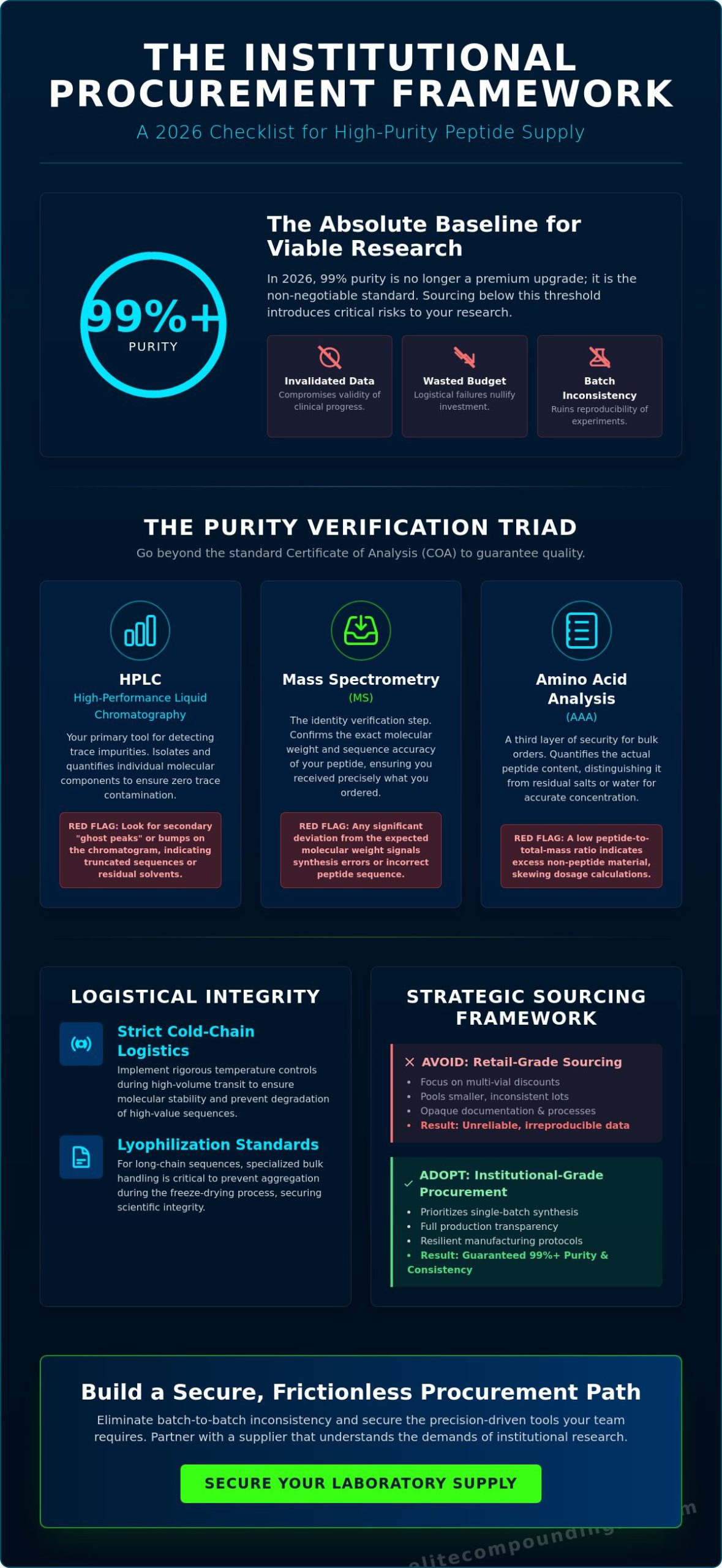
A Certificate of Analysis (COA) is often viewed as the final word on quality, but in high-stakes institutional research, it’s merely the entry point. Relying solely on a vendor-supplied document without understanding the raw data behind it exposes your project to unnecessary risk. When managing a bulk peptide supply, true verification requires a deep dive into the analytical triad of HPLC, Mass Spectrometry, and Amino Acid Analysis. Understanding reagent purity grades is essential for interpreting these results correctly; it ensures that the chemical signatures match the rigorous standards required for pre-clinical applications. Accuracy here is the difference between a breakthrough and a baseline error.
Advanced Analytical Techniques for Bulk Batches
High-Performance Liquid Chromatography (HPLC) is your primary tool for detecting trace impurities that can skew experimental outcomes. In 2026, HPLC serves as the definitive gatekeeper for purity by isolating and quantifying individual molecular components within a sample to ensure zero trace contamination. While HPLC confirms the purity level, Mass Spectrometry (MS) verifies the identity. It ensures the molecular weight and sequence accuracy are exactly what you ordered. For multi-kilogram procurement cycles, Amino Acid Analysis adds a third layer of security by quantifying the actual peptide content versus residual salts or water. This triad ensures that your bulk peptide supply remains consistent from the first batch to the last. When you examine a chromatogram, look for a single, sharp peak. Any secondary bumps or “ghost peaks” indicate the presence of truncated sequences or residual solvents that could interact with your biological assays in unpredictable ways.
Verifying Lab-Grade Credentials
Authentic documentation should always include raw chromatograms rather than just a summary table. Red flags include “ghost peaks” in the HPLC data or significant baseline noise that suggests poor purification. If a vendor cannot provide batch-specific data for every gram, they are likely cutting corners. Integrating these experimental chemicals into your lab safety protocols requires a transparent chain of custody and verifiable third-party testing. You don’t have to navigate these complexities alone. Partnering with an expert like Elite Compounding LLC provides you with the sophisticated data required to maintain institutional integrity. Always cross-reference vendor reports with independent laboratory results to ensure your research rests on a foundation of absolute precision. Reliable data starts with reliable sourcing, and your procurement framework should reflect that commitment to excellence.
Logistical Integrity: Managing High-Volume Peptide Stability
Securing a high-purity bulk peptide supply is only half the battle. The other half is ensuring that the chemical integrity you’ve verified doesn’t degrade before it reaches your lab bench. In 2026, logistical resilience is as critical as the synthesis itself. Lyophilization remains the industry standard for stabilizing bulk quantities because it removes moisture through sublimation, effectively “locking” the peptide structure in a state that resists enzymatic degradation. This powder form provides the thermal stability necessary for long-haul transit and extended storage, ensuring the potency of your sequences remains consistent from day one to year two. Without proper lyophilization, even the most precise sequences are vulnerable to rapid hydrolysis and aggregation.
Lyophilized Powder Storage and Handling
Optimal storage is the foundation of institutional research longevity. While -20°C is sufficient for many short-term projects, -80°C is the professional benchmark for long-term bulk storage of sensitive or long-chain sequences. You should avoid the trap of repeated freeze-thaw cycles, which can fracture delicate peptide bonds and reduce bioactivity. The most efficient strategy involves aliquoting your bulk stock into single-use vials immediately upon receipt. Perform this in a low-humidity, sterile environment to prevent moisture ingress. Moisture is a silent killer of peptide stability; it can cause the lyophilized “cake” to collapse, leading to irreversible degradation. Proper aliquoting ensures you only expose what you need, protecting the remainder of your investment.
Cold-Chain Verification and Monitoring
High-value institutional shipments require more than just a “perishable” sticker. You need verifiable data. Implementing active data loggers in your bulk peptide supply shipments provides a transparent temperature map of the entire transit journey. These devices track fluctuations in real-time, allowing you to confirm the shipment stayed within the required -20°C to 8°C window. Evaluate your vendor’s packaging resilience before committing to a contract. High-density insulated shippers and vacuum-sealed secondary containment are essential for international transit where customs delays are common. If a shipment arrives with a compromised logger or signs of cake collapse, the integrity of the batch is compromised. Professional laboratories don’t guess about stability. They demand the data to prove it. This methodical approach to logistics reflects a commitment to efficiency and ensures your research results are never skewed by environmental variables.
Strategic Vendor Vetting: A Procurement Framework
Vetting a partner for your bulk peptide supply is a strategic decision that dictates the reliability of your data. In 2026, institutional procurement has evolved beyond simple price-per-milligram comparisons. It now focuses on a vendor’s ability to maintain precision during rapid scale-up. You must look past the sales deck and evaluate the actual infrastructure. Just as high-precision industrial sectors rely on the standards set by Compass Wire Cloth Corporation for material consistency, your peptide provider must adhere to strict analytical benchmarks. Can the vendor absorb a sudden volume spike? Do they have redundant synthesis platforms? These are the questions that separate high-tier facilitators from mere resellers. A professional partner acts as an extension of your laboratory, prioritizing your project’s timeline as much as its purity.
Lead Times and Production Transparency
Transparency is the bedrock of a secure supply chain. When you engage with an account manager, move beyond “standard delivery times” and ask specific questions about their synthesis queue. If a vendor doesn’t have a clear grasp of their raw material sourcing, your research is at risk of global reagent shortages. Consider the following when negotiating your contract:
- Raw Material Buffers: Does the vendor maintain a 90-day reserve of essential amino acids and solvents?
- Safety Stock Agreements: Can you negotiate a “reserved inventory” model where a portion of your annual requirement is synthesized and held in climate-controlled storage?
- Communication Cadence: Establish a monthly production review to anticipate bottlenecks before they impact your delivery schedule.
Negotiating these points early ensures that your project doesn’t stall due to avoidable logistical friction.
The Florida Advantage: Localized High-Tier Supply
Florida has become a premier destination for specialized research chemicals, offering a unique combination of elite laboratory talent and logistical efficiency. Domestic sourcing from Florida-based hubs reduces the degradation risks inherent in transcontinental shipping. It also bypasses the unpredictability of international customs, which has seen increased scrutiny on bulk peptide supply shipments in 2026. By choosing a domestic partner, you gain direct oversight and faster response times for custom synthesis requirements. Elite Compounding LLC bridges the gap between boutique, high-precision quality and the volume required for institutional trials. This localized approach ensures your sequences spend less time in transit and more time in the lab.
Ready to secure a resilient supply chain for your next project? Connect with Elite Compounding LLC to discuss your high-volume research requirements.
Securing Your Laboratory Supply with Elite Compounding LLC
Precision is non-negotiable in institutional research. When your project transitions from a pilot phase to a high-volume trial, you need more than a vendor; you need a sophisticated facilitator. Elite Compounding LLC acts as that authoritative gateway, providing the specialized resources and technical expertise required to scale your work without compromising scientific integrity. Managing a bulk peptide supply requires a partner who understands that a batch failure isn’t just a loss of material. It’s a loss of time and clinical progress. We prioritize your laboratory’s efficiency by delivering a frictionless procurement experience backed by elite-level methodology.
The Elite Compounding Quality Standard
Our commitment to excellence is rooted in a no-nonsense approach to quality. In 2026, the industry standard has shifted, and we’ve set our baseline at 99%+ purity to meet the rigorous demands of modern experimental chemicals. We don’t just provide a summary report. Every shipment is accompanied by comprehensive documentation, including batch-specific HPLC chromatograms and mass spectrometry data that verify sequence accuracy. By combining internal rigorous testing with independent third-party verification, we ensure that every sequence meets the elite standards your research demands. This level of transparency allows you to integrate our products into your existing safety and procurement workflows with total confidence.
Next Steps for Institutional Procurement
Securing your supply chain should be a seamless process. We offer customized bulk solutions tailored to your specific research goals, whether you’re working with common sequences or specialized, complex chains. We understand the importance of internal verification, which is why we encourage researchers to initiate the process with a sample batch. This allows your team to conduct independent purity verification and stability testing before committing to a larger procurement cycle. Our account managers are ready to assist with technical data, logistical planning, and safety stock agreements to ensure your lab stays operational and optimized.
Contact Elite Compounding LLC to discuss your institutional bulk peptide supply needs.
Empowering Your 2026 Research Milestones
Scaling institutional research requires more than volume; it requires a commitment to analytical precision and logistical integrity. You’ve learned that 99%+ purity verified by HPLC and Mass Spectrometry isn’t a luxury but a baseline for reproducible data. By prioritizing these verification standards and resilient cold-chain protocols, you protect your laboratory from the variables that derail clinical progress. A professional procurement framework transforms your supply chain from a potential bottleneck into a streamlined asset.
Success in 2026 depends on a bulk peptide supply that is as consistent as it is sophisticated. Choosing a Florida-based professional laboratory provides the domestic oversight and dedicated institutional account management your project deserves. This strategic approach ensures your procurement process remains a seamless gateway to elite results without the friction of international customs or batch inconsistency. It’s time to elevate your laboratory standards with a partner that values your timeline and your data.
Secure Your Institutional Peptide Supply with Elite Compounding LLC. Your work defines the next level of optimization, and we’re here to provide the precision-driven tools to get you there. Let’s build a future of uncompromising quality together.
Frequently Asked Questions
What is considered a ‘bulk’ quantity in peptide research?
A bulk quantity is generally defined as any order exceeding 10 grams of a single peptide sequence produced in a single synthesis batch. Institutional research requirements often push these volumes into the 100g to 1kg range to ensure experimental consistency. Moving to this scale allows laboratories to eliminate the batch-to-batch variability found when pooling multiple smaller retail vials, providing a more stable foundation for long-term trials.
How do I verify the purity of a 100g+ peptide order?
Verifying a 100g+ order requires a comprehensive analytical triad consisting of HPLC, Mass Spectrometry, and Amino Acid Analysis. High-Performance Liquid Chromatography isolates individual components to confirm a 99% purity baseline, while Mass Spectrometry verifies the molecular weight and sequence identity. For large volumes, Amino Acid Analysis is essential to determine the actual peptide content versus residual salts or moisture, ensuring you receive the exact mass required.
Can I request a custom Certificate of Analysis for my bulk purchase?
You can absolutely request a batch-specific Certificate of Analysis that includes raw chromatograms and mass spectra for your specific synthesis run. Transparent documentation is a hallmark of a professional bulk peptide supply. Elite Compounding LLC provides these detailed reports to ensure your procurement team has the technical data required to validate every gram before it enters your laboratory environment, supporting total experimental integrity.
What is the shelf life of bulk lyophilized peptides when stored at -20°C?
Bulk lyophilized peptides typically maintain stability for up to 24 months when stored at -20°C in a desiccated, airtight environment. For long-term institutional projects exceeding two years, -80°C is the preferred benchmark to prevent slow degradation. It is vital to avoid frost-free freezers because the temperature fluctuations in these units can cause moisture ingress and irreversible peptide hydrolysis over time, compromising your research results.
Does Elite Compounding LLC offer tiered pricing for institutional buyers?
Institutional buyers have access to tiered pricing structures that reflect the efficiencies gained during large-scale synthesis and purification. As your volume requirements increase, the cost per gram typically decreases due to streamlined production and reduced setup cycles. We provide customized quotes based on your specific sequence complexity and annual volume forecasts, allowing your department to optimize its budget while maintaining elite quality standards for every batch.
How are bulk peptide orders protected during international shipping?
International shipments are protected through a combination of high-density insulated packaging, vacuum-sealed secondary containment, and active data loggers. These loggers provide a transparent temperature map of the entire journey to confirm the cold-chain remained intact. In 2026, the global bulk peptide supply chain faces increased customs scrutiny, so we utilize specialized couriers that prioritize clinical-grade handling and provide real-time tracking for every high-value institutional shipment.
What is the typical lead time for a custom bulk peptide synthesis?
Typical lead times for custom bulk synthesis range from three to six weeks depending on the length and complexity of the peptide sequence. Simple sequences may be completed faster, while multi-step purification and rigorous third-party verification for complex chains can extend the timeline. We recommend establishing a production schedule at the start of your contract to ensure a consistent flow of materials for your ongoing research trials and pilot studies.
Are your research peptides compliant with internal institutional safety audits?
Our research peptides are designed to integrate seamlessly into rigorous institutional safety and compliance audits. We provide the comprehensive documentation, including Safety Data Sheets (SDS) and batch-specific purity reports, required by internal review boards for chemical handling. This level of transparency ensures your laboratory meets all regulatory expectations for experimental integrity. Our team supports your procurement officers with the technical data needed for a frictionless and secure approval process.
https://shorturl.fm/JAECr
https://shorturl.fm/seheN