Navigating Experimental Chemicals: A Guide to Professional Laboratory Procurement
In 2026, the integrity of your research is directly proportional to the rigor of your chemical procurement framework. You can’t build a breakthrough on a foundation of inconsistent batch purity or missing documentation. Sourcing high-quality experimental chemicals requires more than just a standard purchase order; it demands a sophisticated verification strategy that eliminates the risk of contamination in sensitive in-vitro studies.
You’ve likely felt the frustration of a stalled project because a vendor failed to provide transparent chemical analysis. It’s a common pain point that compromises reliable data sets and wastes valuable laboratory time. This guide empowers you to master the rigorous protocols for sourcing, verifying, and implementing these compounds in high-standard environments. We’ll examine how to navigate the May 2026 EPA and OSHA updates, streamline your procurement workflow, and ensure full transparency from the first batch to the final result. Whether you’re preparing for the July 2026 DEA rule changes or seeking elite research peptides, this roadmap secures your path to precision and professional optimization.
Key Takeaways
- Distinguish between research-grade and pharmaceutical-grade standards to ensure your laboratory analysis remains compliant and scientifically rigorous.
- Learn why the Certificate of Analysis is your most critical document when verifying the purity and identity of experimental chemicals.
- Identify the logistical and security benefits of partnering with specialized domestic labs over mass-market generic chemical suppliers.
- Adopt a professional five-step protocol to define molecular requirements and vet vendor credentials before any purchase.
- Streamline your procurement of high-purity research peptides through elite facilitators that value your time and data integrity.
What are Experimental Chemicals? Defining the 2026 Research Scope
Precision drives progress. In 2026, defining experimental chemicals requires a shift from viewing them as mere substances to seeing them as precision-engineered tools for discovery. These compounds are strictly intended for in-vitro and laboratory analysis, serving as the foundation for high-standard research environments. Unlike mass-market alternatives, these materials are designed to meet the rigorous demands of reproducible science. You can’t achieve elite results with sub-standard inputs.
The gap between pharmaceutical-grade and research-grade materials is a matter of intent and documentation. While pharmaceutical grades focus on clinical safety for human use, research-grade compounds prioritize chemical identity and purity for analytical accuracy. High-purity chemicals enable researchers to isolate variables with confidence. If your purity levels fluctuate, your data becomes noise. This is why professional labs prioritize the molecular fidelity found in research-specific batches rather than repurposed commercial products.
Adhering to 21CFR labeling requirements remains the gold standard for institutional compliance. This framework ensures that every vial is tracked, identified, and used within its legal scope. It’s the difference between a secure laboratory environment and a regulatory liability. By 2026, the integration of GHS Revision 7 standards has further refined how these substances are classified, making clear documentation a non-negotiable asset for any serious investigator who values transparency and safety.
The Legal and Ethical Framework for Lab Use
The “Laboratory Use Only” designation is a hard regulatory boundary. It’s not a suggestion; it’s a legal safeguard that separates experimental work from clinical practice. Institutional research demands a level of transparency that generic retail stores simply can’t provide. Professional procurement means moving away from “off-the-shelf” solutions and toward specialized partners who understand the non-clinical protocols required for research chemicals. This separation protects the researcher and the integrity of the study, ensuring a frictionless environment for innovation.
Common Categories of Research Compounds
Modern research often centers on specific molecular classes that require high-density information and purity. In the 2026 experimental landscape, these categories have become increasingly specialized:
- Research peptides: These include complex sequences used as signaling molecules or antimicrobial research targets, allowing for the study of biological pathways without bulk additives.
- Small molecules: Specialized synthetic catalysts and building blocks used primarily in chemical engineering and molecular biology.
- Designer compounds: Highly specific molecules engineered for niche applications, providing elite tools for next-level optimization.
These advancements empower researchers to push the boundaries of what’s possible in a controlled, analytical setting. By selecting the correct category of experimental chemicals, you ensure that your procurement process aligns with the sophisticated goals of your laboratory.
Decoding Chemical Purity: How to Verify High-Purity Compounds
Purity isn’t just a number; it’s the security of your data. While some vendors claim absolute perfection, seasoned researchers know that “100% purity” is a statistical impossibility in chemical manufacturing. A realistic benchmark for high-quality experimental chemicals falls between 98% and 99%. Even a 1% variance isn’t just “filler.” It represents potential contaminants that can introduce unknown variables into sensitive in-vitro models, potentially skewing your entire data set. Verifying chemical purity against established primary standards is a foundational step that separates professional inquiry from guesswork.
Don’t rely solely on supplier-provided data without a verification framework. Third-party testing acts as an external audit, providing an unbiased layer of security that confirms analytical results haven’t been cherry-picked. This level of scrutiny is what ensures your results are reproducible across different studies and institutional environments. When the stakes are high, the difference between a successful study and a failed replication often lies in the quality of the initial compound.
Essential Analytical Techniques: HPLC and Mass Spec
To confirm these levels, labs rely on sophisticated instrumentation that provides a molecular fingerprint of the substance. High-Performance Liquid Chromatography (HPLC) serves as the primary tool for purity quantification in a laboratory setting. This technique separates the compound from any residual impurities, allowing for a precise readout of the actual concentration. Complementing this, Mass Spectrometry verifies the molecular weight and identity of the compound. Together, these methods ensure that the experimental chemicals you implement are exactly what the molecular formula promises.
Reading a Certificate of Analysis (COA)
The Certificate of Analysis (COA) is the most important document in your lab. It’s your receipt of quality and your first line of defense against sub-standard materials. A legitimate COA must include a specific batch number and a date of manufacture. These details are vital for stability tracking and ensuring the compound hasn’t degraded over time. When you interpret the chromatogram, look for sharp, distinct peaks. A single, tall peak indicates a pure substance, while smaller, jagged peaks suggest the presence of unwanted contaminants.
You must remain vigilant for red flags in documentation. Missing headers, generic dates, or a lack of professional signatures often signal a failure in quality control. If a supplier can’t provide a clear, third-party validated COA, they aren’t a professional partner. For those who prioritize rigorous standards and logistical security, sourcing from a transparent provider like Elite Compounding LLC ensures that every batch of research peptides is backed by the necessary documentation for secure, high-level research.
Evaluating Experimental Chemical Suppliers: A Comparative Analysis
Your procurement strategy defines your research ceiling. Choosing a supplier isn’t just a transactional decision; it’s about selecting a professional partner who understands the high stakes of your work. Mass-market generic stores often prioritize volume over precision, leaving researchers to deal with inconsistent batches and opaque sourcing. In contrast, specialized boutique labs act as sophisticated facilitators. These providers focus on the molecular integrity of experimental chemicals, ensuring that every compound meets the specific analytical requirements of high-standard research environments.
Sourcing within the United States, particularly from Florida-based facilities, provides a significant layer of logistical security. You gain immediate transparency and a verifiable chain of custody that international vendors can’t replicate. Domestic partners are physical entities subject to strict local oversight, which guarantees a level of accountability that protects your laboratory’s reputation. When you source locally, you aren’t just buying a product; you’re securing a streamlined path from the lab bench to reliable data sets.
High-purity compounds are inherently fragile. The shipping method is just as critical as the chemical itself, as improper handling can render a premium compound useless. Professional suppliers treat cold-chain logistics as a core component of their quality assurance process. This attention to detail prevents degradation during transit, ensuring that the material arriving at your facility is as potent and pure as the day it was synthesized.
Domestic vs. International Sourcing Risks
International procurement introduces variables that can compromise your study. Customs delays often extend transit times by several weeks, exposing temperature-sensitive compounds to uncontrolled environments. This degradation is frequently invisible until your results fail to replicate, wasting months of effort. Florida-based compounding and research suppliers eliminate these hurdles by offering direct oversight and rapid transit. Choosing a domestic partner ensures your supply chain remains resilient and your data stays untainted by logistical failures.
Stability and Storage Standards
Stability is the prerequisite for scientific accuracy. Lyophilization, or freeze-drying, is the gold standard for maintaining the long-term integrity of experimental chemicals. This process removes moisture while preserving the molecular structure, creating a stable powder that resists environmental degradation. You must maintain rigorous storage protocols; lyophilized powders require climate-controlled settings, while reconstituted solutions are far more volatile. Even minor temperature fluctuations can lead to inconsistent results, making high-standard storage equipment a non-negotiable asset for your lab.
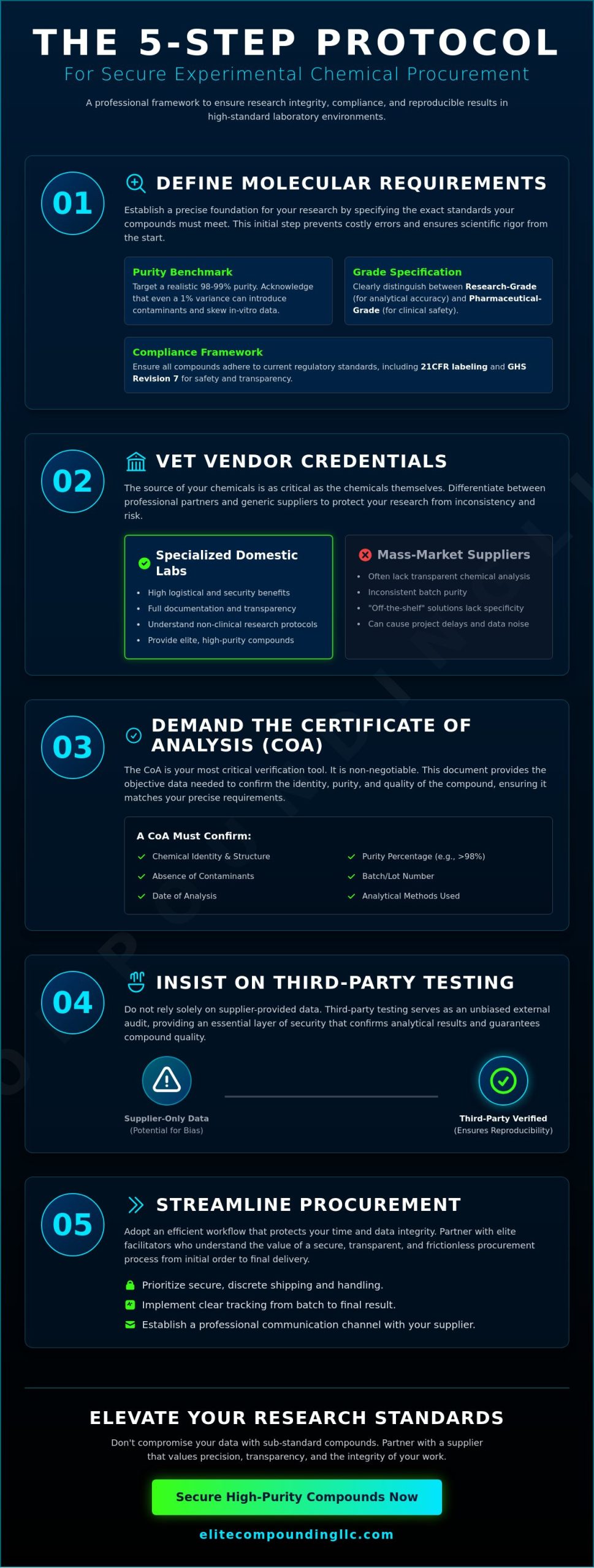
The 5-Step Protocol for Secure Chemical Procurement
Establishing a secure supply chain requires a methodical, step-by-step approach. You can’t leave your data to chance by skipping verification steps. This 5-step protocol transforms the procurement of experimental chemicals from a logistical hurdle into a competitive advantage for your laboratory. By following this sequence, you ensure that every compound entering your facility meets the elite standards required for high-level research.
- Identify: Clearly define the specific molecular requirements and purity targets for your study. Precision at this stage prevents costly errors during implementation.
- Vet: Review vendor credentials, third-party lab reports, and physical locations. A supplier who hides behind a PO box isn’t a professional partner.
- Sample: Execute a pilot batch test. Verify consistency with your institutional equipment before committing to larger volumes.
- Verify: Cross-reference the provided COA with in-house or independent mass spectrometry. This step confirms the molecular weight and identity match the documentation.
- Scale: Establish a long-term supply agreement with a verified partner. Secure your future research by partnering with Elite Compounding LLC for reliable, high-purity research peptides.
Phase 1: Initial Vendor Vetting
Success begins with rigorous screening. When evaluating a potential supplier, ask direct questions about their batch-to-batch consistency and their specific synthesis methods. Request historical COA data from the past 12 to 24 months to prove long-term adherence to purity standards. A transparent vendor will have this data readily available. Additionally, check for institutional references or a strong reputation within the scientific community. If other high-standard labs trust the source, it’s a strong indicator of reliability.
Phase 2: Logistics and Implementation
Once you’ve selected a partner, integrate their supply into your existing laboratory information management system (LIMS). This allows for seamless tracking of batch numbers and expiration dates. You should also set up a “blind” verification process for incoming batches, where the lab technician testing the material doesn’t know the expected result. This eliminates bias and ensures the experimental chemicals truly meet your specifications. Finally, establish a direct feedback loop with your supplier. This communication is essential for custom synthesis needs and ensures your partner remains aligned with your evolving research goals. For institutions managing high-volume orders, following a structured bulk peptide supply checklist can further safeguard purity standards and streamline the entire procurement lifecycle.
Elevating Research Standards with Elite Compounding LLC
Elite Compounding LLC acts as a dedicated facilitator for the 2026 scientific community, bridging the gap between clinical-grade precision and specialized laboratory needs. We understand that your research is only as reliable as the compounds you utilize. While global chemical distributors often provide an impersonal, transactional experience, we function as a professional partner invested in your project’s success. By focusing exclusively on high-standard experimental chemicals, we ensure that every researcher has access to the elite tools necessary for groundbreaking discovery.
Our Florida-based facility combines high-purity standards with streamlined logistics to eliminate the common friction points of procurement. We’ve optimized our entire operation to support the fast-paced nature of modern science, ensuring that your supply chain remains secure and responsive. Choosing a specialized expert over a mass-market retailer means you receive a curated catalog backed by deep technical knowledge. This focus on research peptides ensures that our team speaks your language and understands the molecular nuances required for your specific in-vitro models.
The Elite Guarantee is built on a foundation of transparency and precision. We don’t just ship products; we provide institutional-grade documentation that stands up to the most rigorous internal audits. Every batch is an opportunity to prove our commitment to your data integrity, providing you with the peace of mind that comes from absolute chemical certainty.
Our Commitment to Purity and Precision
We utilize advanced compounding methodologies to prepare experimental materials that meet exacting specifications. Our internal testing protocols are designed to exceed industry averages, incorporating multiple layers of verification before any compound leaves our lab. Our facility in Wellington, FL, serves as a premier hub for research excellence, providing a localized center for quality control and logistical efficiency. This proximity allows us to maintain a chain of custody that international suppliers simply cannot match, protecting the potency and stability of your materials from synthesis to delivery.
Securing Your Institutional Supply Chain
Navigating the procurement landscape in 2026 requires a partner who understands the needs of both large universities and private research firms. We’ve simplified the path to acquisition, offering customized support for high-volume requirements and specialized peptide sequences. Whether you are scaling a long-term study or beginning a pilot batch, our team provides the technical guidance and logistical security your institution demands. Don’t let sub-standard materials compromise your results. Secure your high-purity research materials today and ensure your laboratory operates at the peak of professional standards.
Accelerate Your Research with Precision Sourcing
Success in the modern laboratory depends on a commitment to uncompromising quality. You’ve seen how verifying purity benchmarks and securing a transparent supply chain serve as your primary defenses against contaminated data. By implementing a rigorous procurement protocol, you transform your laboratory from a standard facility into a hub of scientific excellence. This methodical approach ensures your data remains reliable and your institutional reputation stays secure.
Sourcing experimental chemicals shouldn’t be a gamble. Elite Compounding LLC offers a frictionless path to discovery through our Florida-based high-purity laboratory. We provide a verified 2026 Certificate of Analysis for every batch, specifically tailored to support our specialized focus on institutional research supply. This level of transparency empowers you to focus on analysis rather than troubleshooting sub-standard materials.
Access the Elite Catalog of High-Purity Research Peptides
Take control of your analytical outcomes and move forward with the confidence that only elite-grade materials can provide. Your next breakthrough is waiting.
Frequently Asked Questions
What is the difference between research chemicals and designer drugs?
Research chemicals are substances strictly intended for laboratory analysis, whereas designer drugs are often illicit analogs created for human consumption. The distinction lies in the legal “Laboratory Use Only” designation and the presence of rigorous documentation. Research compounds are precision-engineered for analytical accuracy, while designer drugs bypass these professional standards and safety protocols.
How should I store lyophilized experimental chemicals for maximum shelf life?
You should store lyophilized experimental chemicals in a climate-controlled environment, ideally a freezer at -20°C for long-term stability. Maintaining a dry, dark environment prevents the moisture-induced degradation that can compromise your study. Once a compound is reconstituted, its shelf life drops significantly, requiring immediate use or short-term refrigeration to maintain molecular integrity.
Why does the color of a chemical powder vary between batches?
Color variations often stem from subtle differences in the lyophilization process or minor variances in salt forms during synthesis. A slight shift from white to off-white doesn’t necessarily indicate a loss of purity if your HPLC results remain within the 98-99% benchmark. Always refer to your Certificate of Analysis to confirm the chemical identity remains consistent regardless of these minor visual shifts.
Can I use experimental chemicals for veterinary research in 2026?
Using experimental chemicals for veterinary research in 2026 requires strict adherence to your institution’s Institutional Animal Care and Use Committee (IACUC) guidelines. You must also account for updated 2026 regulations, such as the DEA’s proposed rule on manufacturing and procurement quotas for List I chemicals. Ensure your study protocols align with these federal requirements to maintain institutional compliance and research integrity.
What are the red flags to look for in a research chemical store?
Red flags include a lack of transparent third-party testing, missing physical laboratory addresses, and the absence of a verifiable Certificate of Analysis. If a supplier uses vague marketing terms instead of technical purity percentages, they aren’t a professional partner. A reliable source will always provide clear batch numbers and direct contact information for their analytical laboratory.
How do I verify the authenticity of a Certificate of Analysis?
To verify a COA, you should contact the independent laboratory that performed the testing to confirm the batch number and results match their records. Professional suppliers use reputable third-party facilities that maintain verifiable records of their analysis. If the chromatogram looks generic or lacks a professional signature and date, it’s a sign that the documentation may not be authentic.
What is the standard lead time for high-purity peptide synthesis?
Standard lead times for high-purity peptide synthesis typically range from two to four weeks depending on the sequence complexity and required purity levels. Specialized sequences or high-volume orders might require additional time for rigorous purification and lyophilization. Establishing a long-term agreement with a domestic partner can often streamline these timelines and provide more predictable delivery schedules for your lab.
Are experimental chemicals subject to the same regulations as generic drugs?
No, these substances are not regulated like generic drugs because they operate under specific “Laboratory Use Only” frameworks. While they avoid clinical retail regulations, they must comply with the May 2026 OSHA HazCom updates and the EPA’s Workplace Chemical Protection Program. This specialized regulatory landscape ensures that materials are handled safely within a professional research context rather than a mass-market pharmacy environment.