
Tesamorelin Peptide: A Comprehensive Research Guide for Laboratory Analysis
Most growth hormone secretagogues function as blunt instruments, but the tesamorelin peptide is a precision-engineered scalpel designed for the most demanding metabolic research environments of 2026. You likely recognize the frustration of navigating a market where the line between pharmaceutical-grade purity and inconsistent research-grade materials feels intentionally blurred. It’s difficult to design rigorous experimental protocols when structural data is sparse and vendor reliability is a moving target.
This guide delivers the technical clarity you need to master this potent GHRH analog. We provide a deep-dive analysis into its unique N-terminal modification and the specific metabolic signaling pathways it activates within visceral adipose tissue. You’ll gain a comprehensive understanding of GHRH receptor affinity, learn the exact criteria for identifying high-purity research supplies, and find standardized laboratory reconstitution protocols. We’re moving beyond the basics to provide a sophisticated look at how this peptide drives elite-level results in a controlled setting.
Key Takeaways
- Understand the precise molecular signaling of the tesamorelin peptide as a synthetic GHRH analog and its specific interaction with pituitary receptors.
- Discover how the trans-3-hexenoic acid modification enhances metabolic stability by resisting enzymatic cleavage for more reliable experimental results.
- Explore the specific pathways of visceral adipose tissue reduction and how growth hormone modulation influences glucose metabolism in research models.
- Identify the rigorous HPLC standards required to verify institutional-grade purity and ensure the integrity of your laboratory analysis.
- Master standardized reconstitution protocols and dosing calculations to maintain sample stability and precision throughout your research cycle.
What is Tesamorelin Peptide? Mechanism and Molecular Signaling
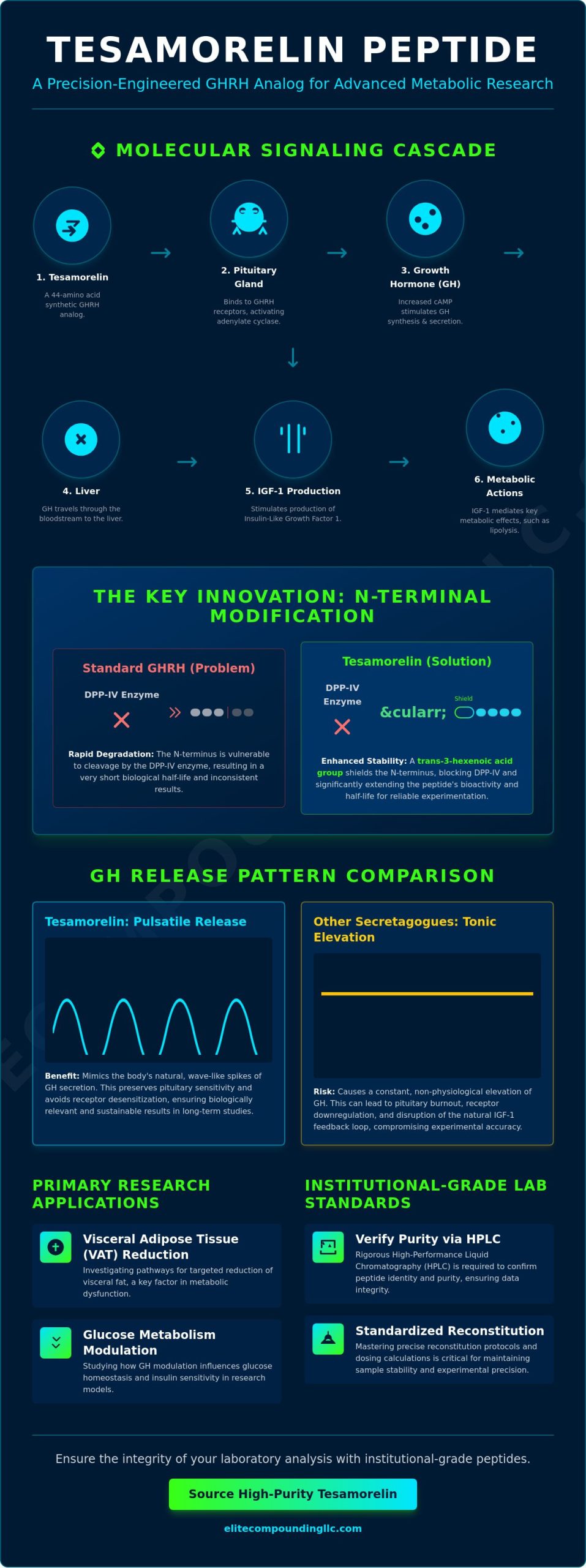
The tesamorelin peptide represents a sophisticated advancement in metabolic research, functioning as a synthetic 44-amino acid analog of endogenous Growth Hormone-Releasing Hormone (GHRH). Unlike generic growth hormone secretagogues that provide a blunt stimulus, this peptide is specifically engineered for high-affinity binding to Growth Hormone-Releasing Hormone Receptors (GHRHR) located in the anterior pituitary. This interaction initiates a precise intracellular signaling cascade. Once the peptide binds to its receptor, it activates adenylate cyclase, which subsequently increases levels of cyclic adenosine monophosphate (cAMP). This cAMP-dependent pathway is the primary driver for the synthesis and secretion of endogenous growth hormone (GH).
Research into this compound often focuses on its ability to stimulate the release of GH in a manner that closely mirrors natural physiological patterns. This downstream effect triggers the liver to produce Insulin-like Growth Factor 1 (IGF-1), which is a critical mediator of the peptide’s metabolic actions. You can find more foundational details on Tesamorelin on Wikipedia regarding its molecular structure and historical development. By focusing on GHRH receptor affinity rather than direct GH administration, researchers can observe metabolic shifts that remain under the control of natural regulatory mechanisms. This approach offers a more nuanced look at pituitary function and hormone regulation than traditional methods.
The Role of GHRH in the Somatotropic Axis
In experimental models, the tesamorelin peptide mimics the hypothalamic signaling that governs the somatotropic axis. This axis is the central regulatory system responsible for maintaining metabolic homeostasis and coordinating tissue growth. While natural GHRH is rapidly degraded by enzymes, synthetic analogs are designed to maintain receptor binding long enough to elicit a robust response. This makes it an ideal tool for studying how pituitary stimulation influences systemic lipid metabolism without bypassing the body’s inherent checks and balances. When comparing natural GHRH to synthetic analogs, the synthetic versions often demonstrate a more stable binding profile, which is vital for long-term laboratory observations.
Pulsatile Release vs. Tonic Elevation
Maintaining a pulsatile rhythm of growth hormone release is essential for experimental accuracy. Many non-pulsatile secretagogues cause a “tonic elevation” that can lead to pituitary burnout or receptor desensitization. Tesamorelin preserves the natural, wave-like spikes of GH, which prevents the downregulation of pituitary sensitivity. This pulsatile action also helps manage the IGF-1 feedback loop, where elevated IGF-1 levels eventually signal the brain to reduce further GH production. For researchers, this means the results reflect a more sustainable and biologically relevant metabolic environment. It ensures that the pituitary remains responsive to stimuli throughout the duration of the study.
Molecular Architecture: The Trans-3-Hexenoic Acid Modification
The chemical integrity of the tesamorelin peptide hinges on a specific structural enhancement at its N-terminus. Unlike endogenous GHRH, which is highly susceptible to rapid degradation, this synthetic analog features a trans-3-hexenoic acid group. This modification isn’t just a minor tweak; it’s a deliberate structural shield. By altering the N-terminal amino acid, the peptide creates steric hindrance that effectively blocks dipeptidyl peptidase IV (DPP-IV) from cleaving the chain. DPP-IV is the primary adversary of peptide stability in biological environments, and by resisting this enzyme, the compound maintains its bioactivity for significantly longer periods.
Solubility and reconstitution profiles are also influenced by this hexenoic group. The addition of this hydrophobic tail slightly alters how the lyophilized powder interacts with solvents compared to unmodified GHRH. You can review Tesamorelin drug information from MedlinePlus to see how these properties impact its clinical stability and storage requirements. When designing experiments, researchers must prioritize high-purity research peptides to ensure that this critical N-terminal modification is present and intact, as any degradation here renders the peptide’s unique stability advantages moot.
Proteolytic Resistance and Pharmacokinetics
In-vitro studies demonstrate that the tesamorelin peptide exhibits a half-life that far exceeds natural GHRH. While endogenous GHRH is often neutralized within 7 to 10 minutes, this modified version remains stable in laboratory buffers for extended observation windows. This proteolytic resistance allows for more precise measurements of growth hormone pulses over time. It provides a reliable window for researchers to track metabolic shifts without the constant need for re-administration, making it a superior model for long-term signaling studies.
Tesamorelin vs. CJC-1295: A Structural Comparison
Researchers often compare this peptide to CJC-1295, but their structural differences dictate very different experimental outcomes. While CJC-1295 often utilizes a D-Alanine substitution at the second position or a Drug Affinity Complex (DAC) to extend half-life, it doesn’t share the same affinity for visceral adipose tissue pathways. The 44-amino acid sequence of the tesamorelin peptide is specifically optimized for pituitary interaction that favors lipolytic signaling in deep abdominal fat models.
| Metric | Tesamorelin | CJC-1295 (No DAC) |
|---|---|---|
| Molecular Weight | ~5135 Da | ~3367 Da |
| Sequence Length | 44 Amino Acids | 29 Amino Acids |
| Terminal Modification | Trans-3-hexenoic acid | D-Alanine (Pos 2) |
| Targeted Receptor | GHRH Receptor | GHRH Receptor |
Primary Research Applications in Metabolic Science
The tesamorelin peptide serves as a rigorous model for investigating lipid mobilization within the somatotropic axis. While many research compounds offer general metabolic stimulation, this peptide is specifically utilized to map the biochemical pathways of visceral adipose tissue (VAT) reduction. Researchers favor this analog because it allows for the study of lipolysis in deep abdominal fat without the systemic instability often associated with direct growth hormone administration. By stimulating the pituitary to release endogenous GH, the peptide provides a more controlled environment for observing how the body prioritizes fat oxidation in specific depots.
Beyond fat mobilization, the compound is a primary focus in glucose metabolism and insulin sensitivity studies. Laboratory models often explore the delicate balance between GH-induced IGF-1 elevation and its subsequent impact on blood glucose levels. This makes it an essential tool for studying growth hormone deficiency (GHD) models, particularly when researchers need to observe the long-term effects of pituitary stimulation on body composition and metabolic health. Its high-affinity receptor binding ensures that experimental data remains consistent across various trial phases.
Lipolysis Mechanisms and Visceral Fat Research
In metabolic research, the ability to selectively target VAT over subcutaneous fat is a critical variable. The tesamorelin peptide activates specific signaling pathways that trigger the breakdown of triglycerides in deep abdominal stores. This mechanism is particularly relevant when investigating hepatic steatosis, or liver fat accumulation, as GH-induced lipolysis can significantly alter intrahepatic lipid content. To ensure precision in these studies, researchers typically track a specific set of biomarkers:
- IGF-1 Serum Levels: Monitoring the primary mediator of GH action.
- Free Fatty Acid (FFA) Mobilization: Quantifying the rate of lipid breakdown.
- Intrahepatic Lipid Content: Measuring changes in liver fat via spectroscopy.
- Waist-to-Hip Ratio: Tracking morphological shifts in VAT-heavy models.
Cardiovascular and Neuroendocrine Research
The scope of GHRH analog research extends into the cardiovascular system, specifically regarding arterial health. Experimental designs often incorporate the measurement of carotid intima-media thickness (cIMT) to determine if pituitary stimulation can influence the progression of subclinical atherosclerosis. Studies suggest that the reduction of visceral adipose tissue directly correlates with a decrease in pro-inflammatory markers and improved cardiovascular risk profiles. Additionally, the neuroendocrine community is increasingly looking at the potential neuroprotective effects of GHRH signaling, investigating whether these pathways can support cognitive health in aging models. This multi-faceted utility makes the peptide a cornerstone of modern metabolic and endocrine research.
Sourcing High-Purity Research Peptides: Lab-Grade Standards
Securing institutional-grade materials is the most critical step in experimental design. For the tesamorelin peptide, 99%+ purity isn’t a marketing claim; it’s a laboratory necessity. High-Performance Liquid Chromatography (HPLC) remains the gold standard for verifying this purity. It provides a visual chromatogram where the primary peak represents the target peptide, and any smaller peaks indicate impurities or degradation products. When your research depends on precise pituitary stimulation, even a 2% variance in purity can introduce enough noise to invalidate your metabolic data.
Mass Spectrometry (MS) serves as the secondary layer of verification. While HPLC tells you how much of the material is pure, MS confirms that the material is actually the tesamorelin peptide by measuring its molecular mass. Given the complex 44-amino acid sequence and the trans-3-hexenoic acid modification discussed earlier, MS is vital to ensure the sequence identity is accurate. Quality lyophilization also plays a role in this process. A well-formed lyophilized cake indicates a stable, moisture-controlled environment that preserves the peptide’s structural integrity during transit and storage.
Reading a Certificate of Analysis (COA)
A Certificate of Analysis is your window into the synthesis quality. You should look for three specific metrics: purity percentage, peptide content, and moisture levels. A purity of 99% means only 1% consists of synthesis byproducts. However, peptide content is equally important. This measures the actual weight of the peptide relative to residual salts and water. High-grade suppliers are transparent about these figures. They also test for common contaminants like Trifluoroacetic acid (TFA) or heavy metals, which can skew metabolic research results. To maintain the highest experimental standards, you should source high-purity research peptides from verified distributors who provide these detailed reports.
Cold-Chain Logistics and Storage Requirements
Peptide bond integrity is highly sensitive to temperature fluctuations. While lyophilized powder is relatively stable at room temperature for short durations, long-term storage requires strict cold-chain protocols. In a professional laboratory setting, -20°C is standard for short-term use, while -80°C is preferred for long-term preservation. You should always inspect the lyophilized cake upon arrival. A collapsed or melted appearance suggests moisture infiltration or temperature excursions during shipping. These physical signs of degradation often correlate with a loss of bioactivity, which will inevitably compromise your data set. Proper storage ensures that the N-terminal modifications remain intact and ready for precise reconstitution.
Laboratory Implementation: Reconstitution and Protocol Design
Precision is the final frontier in successful laboratory analysis. Once you’ve secured institutional-grade materials, the focus shifts to maintaining the structural integrity of the tesamorelin peptide during reconstitution. This process is more than just mixing; it’s a critical step where mechanical stress can easily shear the delicate 44-amino acid sequence. Researchers typically choose between Bacteriostatic Water (0.9% benzyl alcohol) and Sterile Water for Injection based on the study’s duration. While Bacteriostatic Water allows for multiple draws over several days, Sterile Water is preferred for single-use applications where preservatives might interfere with sensitive in-vitro assays.
Dosing calculations must be exact to maintain the validity of your data. Converting lyophilized mass into a specific concentration (mg/mL) requires careful volumetric math. If your experimental design calls for high-frequency administration, even a minor calculation error can lead to cumulative dosing discrepancies. Handling precautions are equally vital. You must avoid any vigorous agitation or shaking, as the physical bonds of the peptide are susceptible to degradation from mechanical force. Maintaining a stable environment from the moment of reconstitution is the only way to ensure the results reflect the peptide’s true metabolic potential.
Precision Reconstitution Steps
To reconstitute, aim the diluent at the glass wall of the vial rather than directly onto the lyophilized cake. This technique prevents foaming and minimizes the risk of peptide shearing. Once the liquid is added, gently swirl the vial in a circular motion until the solution is completely clear. Reconstituted samples should be refrigerated immediately at 2°C to 8°C. Most research protocols recommend using the solution within a 72-hour window to ensure maximum bioactivity, though some studies extend this to 14 days when using bacteriostatic diluents in a controlled environment.
Designing an Experimental Protocol
A robust experimental design begins with establishing baseline measurements for endogenous GH and IGF-1 levels. This allows you to quantify the exact degree of pituitary stimulation achieved by the tesamorelin peptide. In animal models, administration frequency often mirrors the natural pulsatile rhythm, typically involving daily intervals to observe long-term metabolic shifts. Accuracy in these steps is paramount. Using a peptide calculator is the most efficient way to ensure your dosing remains consistent across different study groups. Standard research cycles for GHRH analogs generally range from 8 to 12 weeks, providing a sufficient window to observe significant shifts in lipid mobilization and glucose metabolism without inducing receptor desensitization.
Mastering Precision in GHRH Research
The tesamorelin peptide stands as a pinnacle of molecular engineering, offering researchers a stable and highly specific tool for investigating pituitary signaling. You now understand how the unique trans-3-hexenoic acid modification provides the proteolytic resistance necessary for consistent laboratory observation. By prioritizing VAT-specific lipolysis and adhering to rigorous HPLC verification, your experimental models can achieve a level of accuracy that generic analogs can’t match. Success in metabolic science requires more than just a theory; it demands high-standard materials and uncompromising protocol design.
We specialize in institutional research supply to ensure your work is backed by elite-level precision. Every vial is supported by verified 99%+ purity via HPLC and MS analysis, alongside secure cold-chain shipping to maintain bond integrity. It’s time to elevate your experimental standards and drive meaningful progress in the somatotropic field. Secure High-Purity Tesamorelin for Your Next Research Project and start your next optimization journey today.
Frequently Asked Questions
What is the specific amino acid sequence of Tesamorelin?
The tesamorelin peptide consists of a 44-amino acid chain that mirrors human GHRH, but with a trans-3-hexenoic acid group attached to the N-terminal tyrosine. This specific sequence is Tyr-Ala-Asp-Ala-Ile-Phe-Thr-Asn-Ser-Tyr-Arg-Lys-Val-Leu-Gly-Gln-Leu-Ser-Ala-Arg-Lys-Leu-Leu-Gln-Asp-Ile-Met-Ser-Arg-Gln-Gln-Gly-Glu-Ser-Asn-Gln-Glu-Arg-Gly-Ala-Arg-Ala-Arg-Leu-NH2. This architecture is essential for its high-affinity binding to pituitary receptors.
How does the trans-3-hexenoic acid group affect Tesamorelin’s half-life?
The trans-3-hexenoic acid group acts as a chemical shield that blocks the action of the DPP-IV enzyme. While natural GHRH is neutralized in under 10 minutes, this modification extends the half-life significantly in experimental settings. This stability allows for sustained pituitary stimulation and more reliable data collection during long-term metabolic studies.
Can Tesamorelin be used for in-vitro cell culture studies?
Tesamorelin is an excellent candidate for in-vitro cell culture studies focusing on somatotroph function. Researchers use it to investigate the activation of the cAMP-dependent signaling pathway and subsequent growth hormone synthesis. Its stability in laboratory media makes it superior to endogenous GHRH for tracking intracellular cascades over extended periods.
What is the recommended storage temperature for lyophilized Tesamorelin?
Lyophilized powder should be kept at -20°C for short-term storage and -80°C for long-term institutional preservation. Maintaining these temperatures is vital to prevent the degradation of the peptide bonds. Exposure to room temperature should be minimized during the weighing and preparation phases to ensure the integrity of your research sample.
How do I verify the purity of a Tesamorelin research batch?
Purity verification requires a combination of HPLC and Mass Spectrometry (MS) analysis. The HPLC report should show a primary peak representing 99% or greater of the total area, while MS confirms the molecular mass matches the theoretical value of approximately 5135 Da. Always cross-reference these reports with the batch number on your vial.
What is the difference between Tesamorelin and Egrifta?
Tesamorelin is the chemical peptide used in laboratory settings, while Egrifta is the commercial brand name for the FDA-approved drug. Egrifta is specifically used to treat lipodystrophy in HIV patients. Research-grade materials are not for human consumption and lack the clinical excipients found in the pharmaceutical version.
Why is Tesamorelin often researched for visceral fat specifically?
This peptide is researched for visceral fat because it triggers lipolysis specifically in deep abdominal stores through endogenous GH release. It shows a higher degree of selectivity for visceral adipose tissue compared to subcutaneous fat. This makes the tesamorelin peptide a critical tool for researchers studying hepatic steatosis and metabolic dysfunction.
What diluents are compatible with Tesamorelin for laboratory reconstitution?
Compatible diluents include Bacteriostatic Water and Sterile Water for Injection. Bacteriostatic Water is the standard for multi-use vials because the benzyl alcohol prevents bacterial contamination. For single-use in-vitro experiments where preservatives might interfere with cell viability, Sterile Water for Injection is the preferred choice.